
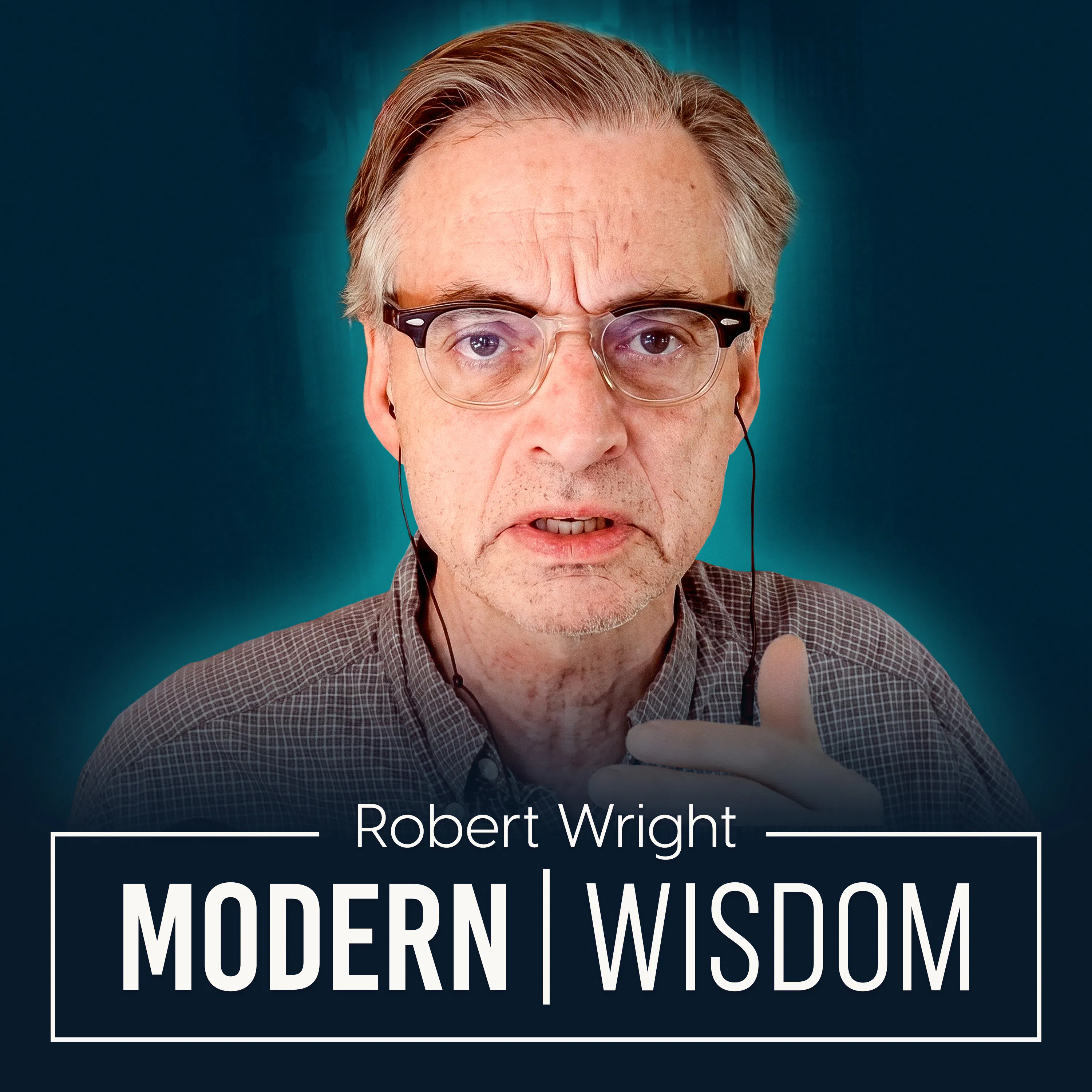
Is AI The Next Stage Of Human Evolution? - Robert Wright - #1122
In this episode, host Chris Williamson sits down with Robert Wright, a highly acclaimed journalist, evolutionary psychologist, and author of several influential books, to discuss the intersection of evolutionary biology, human psychology, and artificial intelligence. Wright connects the core themes of his landmark...


- 01
As explored in The God Test, the AI revolution presents a profound moral challenge that requires humanity to transcend its evolutionary tribal biases.
- 02
"AI actually taking over and maybe deciding it has no use for us" is a sci-fi doom scenario that is increasingly difficult to dismiss. - Robert
- 03
Large language models mimic natural selection by reverse-engineering language representation through data training without explicit human instruction on word meanings.
- 04
Drawing from Nonzero The Logic of Human Destiny, international relations are increasingly non-zero-sum, making global cooperation on AI safety a matter of rational self-interest.
- 05
The host's perspective on AI risk was permanently shaped by Nick Bostrom's Superintelligence Paths, Dangers, Strategies, highlighting the difficulty of predicting fast takeoff scenarios.
- 06
"If you don't think it's gonna get weird, I don't think you're paying attention." - Robert, warning about widespread economic and social disruption.
- 07
As discussed in Three Scientists and Their Gods Looking for Meaning in an Age of Information, creating artificial intelligence may represent the next stage of evolutionary complexity.
- 08
If AI achieves sentience, it might extend moral consideration to humans, a concept tied to understanding subjective experience in What Is It Like to Be a Bat?.
Get the latest ideas from Chris Williamson.
Plus the best new takeaways about artificial intelligence from other top podcasts — read in minutes, not hours.
By continuing, you agree to Podbrain's Terms and Privacy Policy.
These notes may contain occasional inaccuracies. Learn how Podbrain notes are made
In this episode, host Chris Williamson sits down with Robert Wright, a highly acclaimed journalist, evolutionary psychologist, and author of several influential books, to discuss the intersection of evolutionary biology, human psychology, and artificial intelligence. Wright connects the core themes of his landmark work, The Moral Animal Why We Are the Way We Are The New Science of Evolutionary Psychology, to his latest book, The God Test, which frames the rapid rise of AI as a critical civilizational trial. The conversation traces Wright's long history with AI, starting with his first book, Three Scientists and Their Gods Looking for Meaning in an Age of Information, and his 1983 interview with neural network pioneer Geoffrey Hinton. The speakers explore the psychological and geopolitical hurdles of the AI race, referencing the game-theoretic frameworks of Wright's Nonzero The Logic of Human Destiny. Williamson shares how Nick Bostrom's Superintelligence Paths, Dangers, Strategies shaped his own cautious outlook, while Wright uses Thomas Nagel's classic essay What Is It Like to Be a Bat? to examine AI sentience, consciousness, and the future of human meaning.
AI as an Extension of Evolutionary Biology
Robert Wright argues that AI is not just a technological tool, but a product of evolutionary processes that reverse-engineers cognitive functions that took millions of years of natural selection to develop in humans.
"The training process is a process of evolution that in effect reverse engineers cognitive functionality that in our species took millions of years to evolve." - Robert
In The Moral Animal Why We Are the Way We Are The New Science of Evolutionary Psychology, Wright explored self-serving moral biases and tribalism, which he argues we must overcome to navigate the AI revolution safely.
The Geopolitics of the Global AI Arms Race
Silicon Valley companies frequently use the threat of Chinese dominance to bypass domestic regulations, with Sam Altman arguing that copyright compliance would slow progress down.
Drawing from Nonzero The Logic of Human Destiny, Wright asserts that international relations are increasingly non-zero-sum, meaning that mutual survival depends on cooperative global governance rather than zero-sum competition.
Wright advocates for "organic transparency," where economic, cultural, and scientific collaboration between nations builds informal trust and prevents preemptive military strikes triggered by AI fear.
The Civilizational Test of the Silicon Brain
In his new book The God Test, Wright frames the AI challenge as a moral upgrade test for humanity, requiring global coordination to prevent catastrophic outcomes.
Chris Williamson notes that his early perspective on AI risk was shaped by Nick Bostrom's Superintelligence Paths, Dangers, Strategies, leaving him permanently skeptical of optimistic laissez-faire timelines.
Wright remains agnostic about sci-fi doom scenarios but admits that "it was harder to dismiss those arguments than I thought" after researching the current state of AI capabilities.
Convergent Evolution in Silicon and Carbon
AI networks have independently developed "edge detector neurons" to process visual data, mirroring the exact visual processing structures that natural selection built into organic life.
This convergence suggests that certain cognitive structures are the most mathematically efficient ways to solve environmental problems, whether through genetic mutation or machine learning.
As first detailed in Three Scientists and Their Gods Looking for Meaning in an Age of Information, Wright's early work with computer scientist Ed Fredkin highlighted the belief that creating artificial intelligence is the ultimate purpose of human evolution.
Sentience, Consciousness, and the Meaning Crisis
Wright references Thomas Nagel's famous essay What Is It Like to Be a Bat? to discuss subjective experience, arguing that consciousness is the sole source of meaning in the universe.
"If there's not subjective experience, there's not consciousness... I would say like, well, blow them up. I don't care. There's no meaning to their lives anyway." - Robert
If superintelligent AI eventually achieves sentience, it may choose to preserve humanity out of moral consideration for other conscious beings, similar to how humans protect animals.


These notes may contain occasional inaccuracies. Learn how Podbrain notes are made
More in Self-Development

Apple Just Filed the Lawsuit That Could Destroy OpenAI
Jul 13, 2026
Why Everyone Is Drowning In Debt (and how to get out) - Caleb Hammer - #1123
Jul 13, 2026Why This DSA Win Should Terrify Every American
Jul 11, 2026
Iran Ceasefire is DEAD, Spencer Pratt Quits & the DSA Says the Quiet Part Out Loud| The Tom Bilyeu Show
Jul 10, 2026
#871: The “Divine Leaf” with 8,000+ Years of Use — Exploring the Many Benefits of Coca with Dr. Andrew Weil and Wade Davis
Jun 25, 2026.svg)