
And, This Is What The Founding Fathers Were Worried About With Jon Meacham
This conversation features Jon Meacham, presidential historian and Pulitzer Prize-winning author, speaking with California Governor Gavin Newsom about American democracy at a critical juncture. Meacham, who has written biographies of presidents including George H.W. Bush and is currently working on an Eisenhower...


- 01
No American president has ever had Trump's grip on the nation's mind share - it's ubiquity, exhaustion, and constant reality show domination
- 02
We've really only been a multi-racial democracy since 1965 - we're 60 years old as a true democracy, not 250 years old
- 03
The fake electors scheme and durability of election lies represent a difference of kind, not degree, from past political conflicts
- 04
Democracy has to deliver or democracy doesn't survive - without faith that work will be rewarded, people won't support the system
- 05
Just because you have the means to express an opinion quickly does not mean you have an opinion worth expressing quickly
- 06
Despair is a sin, cynicism is a sin - people shed their blood for our freedoms, so self-indulgent despair dishonors their sacrifice
- 07
The most important office in a democracy is the office of citizen - we have agency to shape the future, we're not bystanders
Get the latest ideas from This is Gavin Newsom.
Plus the best new takeaways from other top podcasts — read in minutes, not hours.
By continuing, you agree to Podbrain's Terms and Privacy Policy.
These notes may contain occasional inaccuracies. Learn how Podbrain notes are made
This conversation features Jon Meacham, presidential historian and Pulitzer Prize-winning author, speaking with California Governor Gavin Newsom about American democracy at a critical juncture. Meacham, who has written biographies of presidents including George H.W. Bush and is currently working on an Eisenhower biography, brings his perspective as a self-described centrist and constitutionalist to analyze our current political moment.
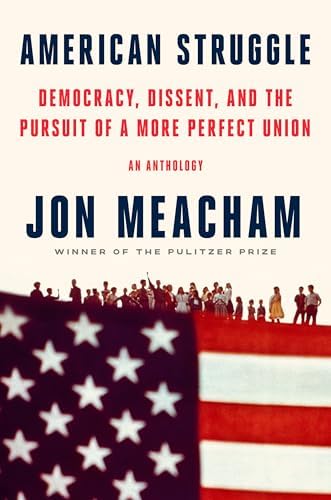
The discussion ranges from the cultural polarization evident in reactions to the Super Bowl halftime show to the unprecedented nature of Trump's election denial and January 6th. Meacham draws on his forthcoming book America's Struggle, which commemorates the 250th anniversary of the Declaration of Independence, and his previous work The Soul of America to frame current challenges within historical context.
Central themes include the fragility of democratic institutions, the importance of citizen agency, and whether America's current divisions represent a difference of degree or kind from past crises. The conversation explores how figures like Frederick Douglass, John Lewis, and Earl Warren navigated previous moments of democratic testing, offering both sobering analysis and measured hope for the republic's endurance.
Trump's Unprecedented Grip on American Mind Share
Meacham argues that 'no American president has ever had the grip on the mind share of the country' that Trump possesses, calling it a strategy of 'ubiquity' and 'exhaustion' that dominates cultural and political discourse.
The politicization of cultural events like the Super Bowl halftime show represents something 'newish' - the notion of debating halftime shows 'in the Reagan years is a little crazy' according to Meacham.
Drawing from Leviathan, Meacham describes Trump's worldview as 'fundamentally Hobbsian' - viewing politics as 'the war of all against all' rather than reasoned deliberation.
The January 6th Inflection Point: Difference of Kind, Not Degree
For nearly four years, Meacham viewed Trump as 'a difference of degree but not kind' - comparable to figures like Huey Long or George Wallace - until the 'unfolding January 6th' changed his assessment.
The fake electors scheme and 'durability of the lies' represent something unprecedented: 'If Mike Pence had not done what he did... What do you do if you have a constitutionally sanctioned remedy for an illegal result?'
Unlike previous losing candidates from Andrew Jackson in 1824 to Al Gore in 2000, Trump's refusal to accept election results breaks the fundamental 'social covenant' that losers accept results because they 'trust the arena.'
America as a 60-Year-Old Democracy, Not 250 Years
Meacham reframes American democratic history: 'We've really only been a multi-racial democracy since 1965. We're 60 years old. We're not 250 years old.'
For those born in the 21st century, their lived experience includes 'September 11th, the failure of intelligence about weapons of mass destruction, the Great Recession, COVID, Trump, January 6th' - explaining distrust in institutions.
The challenge of telling a compelling democratic story becomes harder when 'for more than 20 years now, we have explicitly told our children by our actions that we can't keep them safe in schools.'
The Declaration as America's Operating System
Meacham's forthcoming America's Struggle celebrates the Declaration's 250th anniversary as America's true founding document, elevated by Lincoln at Gettysburg when he 'jumps over 1787 and goes to 1776.'
The Declaration functions as 'scriptural' - Jefferson himself saw it taking on 'sacred dimensions' and Lincoln called it 'a reappearing stumbling block to any kind of tyranny.'
Frederick Douglass exemplifies the Declaration's power: despite being born into enslavement, he declared 'I for one do not despair of this republic. The fiat of the Almighty let there be light has not yet spent its force.'
Democracy Must Deliver or It Doesn't Survive
Meacham emphasizes that 'democracy has to deliver or democracy doesn't survive' - without faith that work will be rewarded and families will prosper, people won't support democratic institutions.
Drawing lessons from Eisenhower's 1950s efforts, Meacham notes how Ike argued for 'mutual security' rather than 'foreign aid' - asking 'why wouldn't you throw a little money their way' rather than 'send the army.'
The middle class remains 'the key to any kind of durable republic' because only with belief that 'rules should be followed' and 'you can benefit from the system' will people support democratic governance.
Historical Perspective on Current Crisis
Reflecting on The Soul of America, Meacham argues the American soul is 'an arena of contention' between competing forces like Dr. King and the Klan - 'a perennial struggle' with no 'once upon a time' or 'happily ever after.'
Comparing 1968 to today, Meacham notes that despite assassinations, Vietnam (46 Americans died daily), and George Wallace winning 13.5% of the vote, 'Nixon governed from the center' and 'had a sense of shame.'
Meacham rejects despair: 'Four years before I was born, we lived in my native region under functional apartheid' - yet John Lewis was willing to die crossing the Pettus Bridge, making current complaints about watching NBC seem 'ridiculous.'
The Power of Individual Agency and Citizenship
Quoting Brandeis, Meacham emphasizes that 'in a democracy, the most important office is office of citizen' - Americans have agency to shape the future rather than being bystanders.
'Despair is a sin, cynicism is a sin' - Meacham argues that self-indulgent despair dishonors those who 'shed their blood for you and me' in previous struggles for democracy.
For election officials facing pressure, Meacham offers this guidance: 'You will be honored beyond the grave if you do the right thing, and the grave is certain, Donald Trump's approval is not.'



These notes may contain occasional inaccuracies. Learn how Podbrain notes are made
More in Politics & Society

AI and Inequality: Nobel-Winning Economist Daron Acemoglu on How to Get AI Right
Oct 29, 2026
And, This Is How Democrats Lead Us To A Post Trump World With Brian Tyler Cohen
Jun 25, 2026
Is it Time for a New Sexual Revolution?
Jun 25, 2026And, This Is Why Reid Hoffman Doesn’t Fear Artificial Intelligence
Jun 19, 2026And, This Is Hunter Biden Like You've Never Heard Him Before
Jun 12, 2026
.svg)