
The Ku Klux Klan: American Fascists (Part 4)
This episode examines the peak and collapse of the second Ku Klux Klan in the mid-1920s, featuring historians Tom Holland and Dominic Sandbrook exploring one of America's largest mass movements.

Episode


- 01
The 1923 Kokomo picnic drew 50,000-200,000 people with circus stunts, boxing rings, and ended with cross burning - typical of hundreds of similar Klan events nationwide
- 02
At its peak, the second Ku Klux Klan attracted 4-5 million members and elected 16 senators, 75 congressmen, and 11 governors by 1924
- 03
Indiana became the Klan's strongest heartland where one-third of adult white males joined under David Stevenson's leadership by 1923
- 04
Hiram Evans, a Texas dentist, seized control of the Klan in 1922 through a Stalin-style coup, becoming Imperial Wizard after ousting founder William Simmons
- 05
The murder of Madge Oberholzer by Grand Dragon David Stevenson in 1925 destroyed the Indiana Klan, reducing membership from hundreds of thousands to 4,000
- 06
Half a million women joined the Klan through groups like Queens of the Golden Mask, organizing picnics and supporting women's suffrage and work rights
- 07
The 1924 Johnson-Reed Act implemented Klan-favored immigration quotas based on the 1890 census, severely limiting southern and eastern European immigration until the 1950s
Get the latest ideas from The Rest Is History.
Plus the best new takeaways from other top podcasts — read in minutes, not hours.
By continuing, you agree to podbrain's Terms and Privacy Policy.
These notes may contain occasional inaccuracies. Learn how podbrain notes are made
This episode examines the peak and collapse of the second Ku Klux Klan in the mid-1920s, featuring historians Tom Holland and Dominic Sandbrook exploring one of America's largest mass movements.
The discussion centers on the 1923 Kokomo picnic in Indiana, where tens of thousands gathered for what appeared to be wholesome family entertainment but ended with cross burning and Klan recruitment. The episode traces how the organization, inspired by The Klansman by Thomas Dixon, evolved from William Simmons' fraternal order into a political powerhouse under Texas dentist Hiram Evans.
The story culminates with the shocking murder of Madge Oberholzer by Indiana Grand Dragon David Stevenson, whose sexual assault and killing of the 28-year-old Methodist woman destroyed the Klan's reputation and triggered its rapid collapse across America.
The Kokomo Spectacle: When Hatred Wore a Family-Friendly Mask
The July 4, 1923 Kokomo picnic drew between 50,000-200,000 people with special trains, circus performers, boxing rings, and a plane with an acrobat doing wing stunts - 'the biggest crowd of 100% red-blooded Americans' according to The Fiery Cross newspaper.
These massive Klan festivals became 'an ordinary, normal, taken-for-granted part of the life of the white Protestant majority' with weddings, beauty contests, rodeos, and spelling bees - historian Kathleen Blee
Half a million women joined through groups like Queens of the Golden Mask and Women of the Ku Klux Klan, with Imperial Empress Daisy Barr recruiting across eight Midwestern states while founding YWCAs and homes for 'fallen women'.
The Texas State Fair Klan Day in October 1923 drew 150,000 people for rodeos and drill teams, but ended with Imperial Wizard Hiram Evans calling African Americans 'savage' and Catholics the 'greatest danger to our institutions'.
The Dentist's Coup: How Hiram Evans Became America's Stalin
Texas dentist Hiram Evans, dismissed by rivals as a 'mere tooth puller,' orchestrated a Stalin-style takeover in November 1922, promoting founder William Simmons to meaningless 'Emperor' while seizing real power as Imperial Wizard.
Evans had led Dallas Klan Lodge 66, notorious for its 'flogging meadow' where members kidnapped and branded victims with acid, before using his control of membership lists to entrench his authority.
The coup eliminated PR duo Edward Young Clark and Elizabeth Tyler, who had been caught 'in bed with a bottle of whiskey' and were accused of embezzling Klan funds while building the organization's membership.
Evans sold the Imperial Palace in Atlanta to the Catholic Church to fund a move to Washington, hiring speechwriters and claiming Grover Cleveland as the Klan's presidential role model.
Indiana's Klan Kingdom Under the False Prophet Stevenson
David Stevenson, a traveling coal salesman who falsely claimed to be a decorated war hero and millionaire's son, recruited one-third of Indiana's adult white male population into the Klan by 1923.
At the Kokomo picnic, Stevenson arrived by plane in a purple robe claiming 'The President of the United States kept me unduly long counseling upon vital matters of state' - a complete fabrication that crowds apparently believed.
Stevenson's 'military machine' compiled detailed dossiers on every political candidate in Indiana, coordinating Protestant ministers, Sunday school newsletters, and election day transportation to achieve near-total electoral success in 1924.
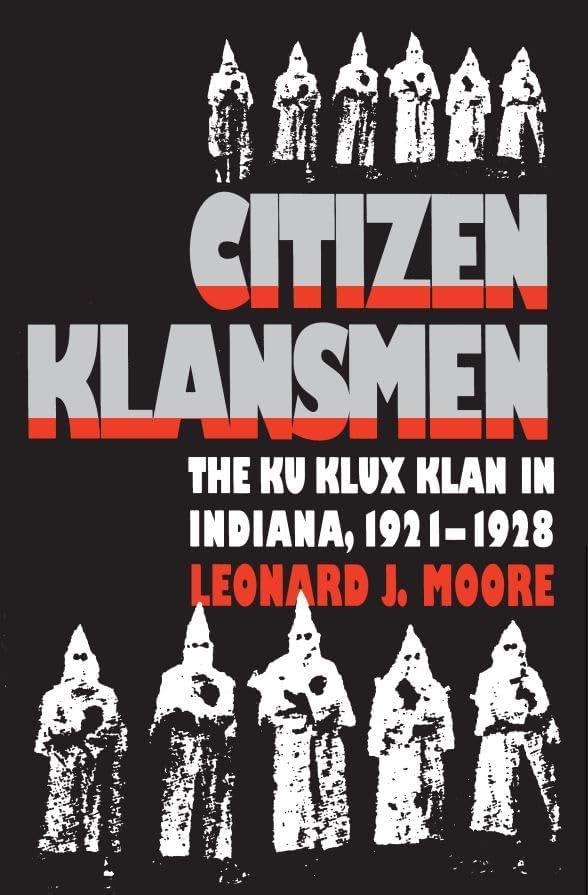
As described in Citizen Klansmen by Leonard Moore, the Indiana Klan combined vigilante violence with ordinary social activities, making membership seem like normal community participation for white Protestants.
The Murder That Destroyed an Empire
On March 15, 1925, Stevenson's men forced 28-year-old Madge Oberholzer, who ran the Indiana Young People's Reading Circle, to drink whiskey before taking her on a train to Chicago where Stevenson repeatedly raped and bit her.
At a Hammond hotel, Oberholzer bought mercury bichloride tablets and attempted suicide, telling Stevenson 'I'm going to set the law on you' - he replied 'I am the law in Indiana'.
Oberholzer died April 14 from infected bite wounds and mercury poisoning; Stevenson was convicted of second-degree murder in November 1925 and sentenced to life imprisonment.
When Governor Ed Jackson refused to pardon him, Stevenson released confidential papers exposing bribes to officials, triggering an earthquake that destroyed Republican control of Indiana and reduced Klan membership from hundreds of thousands to 4,000.
The Klan's Political Overreach and National Collapse
By 1924, the Klan controlled an estimated 16 senators, 75 congressmen, and 11 governors, but failed to become kingmakers when the Democratic Convention rejected both their favored candidate William McAdoo and condemned the Klan by just four votes.
The 1924 Johnson-Reed Act implemented Klan-supported immigration quotas based on the 1890 census, requiring 70% of immigrants to come from Britain, Germany, or Ireland while banning all Asian immigration.
Texas membership collapsed from 13,000 in Dallas alone to barely 1,000 by 1926, with lodges in major cities falling into receivership as anti-Klan candidates swept elections.
The organization's negative vision, entry into mainstream politics, and association with violence like the Oberholzer murder caused membership to hemorrhage nationwide, leading to dissolution for tax reasons by 1939.

These notes may contain occasional inaccuracies. Learn how podbrain notes are made
More in History

679. Germany: The Song Hitler Stole (Part 3)
Jun 14, 2026
Tom Holland Meets Paul McCartney
May 14, 2026Greece vs. Persia: The Battle of Marathon (Part 2)
May 13, 2026
Adolf Hitler (Part 3)
May 13, 2026Greece vs Persia: The Rise of the First Superpower (Part 1)
May 10, 2026.svg)