
How to Think Like a World-Class Marketer | Rory Sutherland
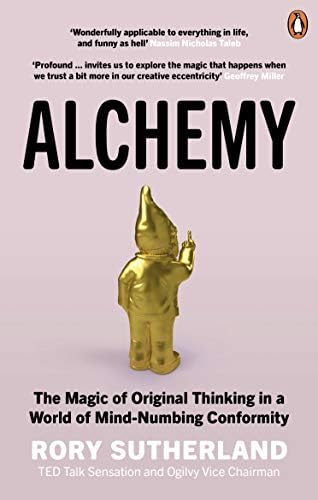
Rory Sutherland, Vice Chairman of Ogilvy and author of Alchemy, joins Shane Parrish for their second conversation after nine years. Sutherland brings his unique perspective as an advertising veteran who applies behavioral psychology to business problems, challenging conventional wisdom about...

Episode


- 01
"People don't decide like that" - Sutherland argues AI interfaces that provide single optimal solutions miss how humans actually make choices through comparison
- 02
"Any idiot can cut costs. What takes real skill is cutting costs in a way that doesn't destroy value" - Roger Martin's insight on business optimization
- 03
The Dorman Fallacy demonstrates how replacing humans with automation often destroys unmeasured value like security, status, and customer recognition
- 04
"The major determinant of whether you liked Royal Mail or not was whether you liked your postman" - human relationships trump operational metrics
- 05
Dyson's philosophy: "We should treat it as an honor if one of our customers chooses to get in touch with us" rather than viewing calls as interruptions
- 06
Private family-owned companies consistently outperform PLCs in marketing effectiveness awards because they optimize for long-term customer value over quarterly results
- 07
Marketing operates on fat-tailed distributions where 5-10% of efforts deliver 110% of value, making hourly billing catastrophically inappropriate
- 08
"The only real measure of innovation is behavioral change" - Stuart Butterfield's test for whether technology truly matters
Get the latest ideas from The Knowledge Project Podcast.
Plus the best new takeaways about marketing from other top podcasts — read in minutes, not hours.
By continuing, you agree to podbrain's Terms and Privacy Policy.
These notes may contain occasional inaccuracies. Learn how podbrain notes are made
Rory Sutherland, Vice Chairman of Ogilvy and author of Alchemy, joins Shane Parrish for their second conversation after nine years. Sutherland brings his unique perspective as an advertising veteran who applies behavioral psychology to business problems, challenging conventional wisdom about efficiency, decision-making, and customer experience.
The conversation explores how businesses optimize for the wrong metrics, often destroying unmeasured human value in pursuit of operational efficiency. Sutherland draws from behavioral economics research, including insights from Nudge by Richard Thaler, to explain why people don't make decisions the way tech companies assume they do.
They discuss the psychology of luxury goods, status signaling through the lens of Geoffrey Miller's The Mating Mind and Spent, and why family-owned businesses often outperform public companies in creating long-term customer value. The conversation also touches on over-regulation critiqued in Philip K. Howard's Life Without Lawyers and the limits of pure rationality explored in John Ralston Saul's Voltaire's Bastards.
Why AI Decision Interfaces Miss How Humans Actually Choose
"I keep hearing people saying, you will say to your AI, find me a skiing holiday, and it will provide you with a perfect skiing holiday. And I keep saying, people don't decide like that" - Sutherland argues humans need comparison options, not single optimal solutions.
The Google "I'm Feeling Lucky" button illustrates this principle - despite being available for years, almost nobody clicks it because "people want to choose between effectively above-the-fold options."
Real estate agents use decoy effects by showing less appropriate, slightly more expensive houses first, creating contrast that makes the target property seem like a clear choice.
As explained in Nudge, people's willingness to pay for identical beer changes dramatically based on whether it's sold at a boutique hotel versus a shack, demonstrating how context shapes perceived value.
The Dorman Fallacy: When Efficiency Destroys Unmeasured Value
Sutherland's Dorman Fallacy describes how management consultants replace doormen with automatic systems, claiming $30-40K savings while destroying unmeasured functions like security, status, and guest recognition.
"Any idiot can cut costs. What takes real skill is cutting costs in a way that doesn't destroy value" - Roger Martin's principle that Sutherland emphasizes throughout business optimization.
Royal Mail discovered that "the major determinant of whether you liked Royal Mail or not was whether you liked your postman" - human relationships trumped all operational efficiency metrics.
People use human judgment as a proxy for evaluating complex services because "we have a quarter of a million, half a million years of evolved experience in deciding who to like and trust."
Dyson's Customer-First Philosophy vs Call Center Metrics
When Dyson executives presented standard call center efficiency metrics, James Dyson stopped them: "You've got this all wrong. We should treat it as an honor if one of our customers chooses to get in touch with us."
This philosophy created "brand quakes" - extraordinary service experiences that generated fanatical loyalty, leading customers like Sutherland's father to own four Dyson vacuum cleaners.
"Your call center is the only way you can find out the problems that people can't solve anywhere else" - it should be positioned near the boardroom, not optimized for speed.
The best service organizations provide both streamlined efficiency for simple requests and human intervention for complex problems requiring empathy and rule-breaking authority.
Why Family-Owned Companies Outperform PLCs in Marketing
"Four out of the five gold winners" in UK advertising effectiveness awards were family-owned companies, not PLCs, because they optimize for long-term customer value over quarterly results.
Buffett's directive to CEOs captures this mindset: "treat this company as if you and your family have 100% of your money in it for 100 years and you can't take it out."
Private companies like Dyson can invest in extraordinary customer service because they're not constrained by quarterly earnings pressure and shareholder value optimization.
"When you look after your staff better, the customer notices" - family companies like Costco demonstrate how employee treatment directly impacts customer experience.
The Fat-Tailed Nature of Marketing and Innovation
"Marketing is actually fat-tailed... 5% to 10% of what you do delivers perhaps 110% of the value" - making hourly billing catastrophically inappropriate for creative work.
An Ogilvy Australia idea generated "in excess of a billion dollars" over 10 years for a major American company, but the agency was paid only $350,000 Australian dollars total.
"You don't find entrepreneurs in chess clubs. You find entrepreneurs in casinos" - high-variance activities require different evaluation and compensation models than predictable processes.
The pharmaceutical industry accepts that most R&D spending fails while seeking blockbuster drugs, but marketing departments are expected to show quarterly returns on every investment.
Status Signaling and the Psychology of Luxury Consumption
Drawing from Geoffrey Miller's The Mating Mind and Spent, Sutherland explains that luxury purchases serve dual purposes: signaling to others and "signaling to ourselves" with phrases like L'Oreal's "because I'm worth it."
Cost per entertainment hour provides rational justification for expensive items - a $100 computer game played for 100 hours costs $1 per hour versus $10+ per hour for movies.
"If you haven't got much money, TV as a source of long-term entertainment is spectacularly cheap" - defending poor people's decisions to buy large televisions against wealthy critics.
Will Storr's The Status Game demonstrates how status currencies change over time, but the underlying human drive for status signaling remains constant across cultures and eras.
Over-Regulation and the Death of Human Judgment
Philip K. Howard's Life Without Lawyers argues that "over-intrusion of law and regulation into practices which should properly be left to subjective human judgment" causes economic decline.
"You can't get fired for following the rules" creates a culture where people avoid subjective decisions even when common sense would dictate otherwise.
John Ralston Saul's Voltaire's Bastards critiques how "we've made rationality the gold standard" despite humans evolving "a variety of mental capabilities" including imagination, creativity, and common sense.
In advertising, "if you came up with a rational ad, people go, 'Yeah, it's all right, but can you do a bit better?'" - rationality is the starting point, not the end goal.




These notes may contain occasional inaccuracies. Learn how podbrain notes are made
More in Self-Development

Can the Middle Class Be Saved? Political Division, Economic Doom & The Leadership Problem | Andrew Bustamante Pt. 2
Jun 20, 2026
The Career Trap That Makes Women Miserable - Suzanne Venker - #1113
Jun 20, 2026
How Immigration and War Test the Strength of Values and National Identity
Jun 19, 2026
7 Strategies for Becoming a Better Father | FRIDAY FIELD NOTES
Jun 19, 2026
ELECTROMAGNETISM Is The SECRET To Health: Biofield Tuning Explained | Eileen McKusick
Jun 15, 2026
.svg)