
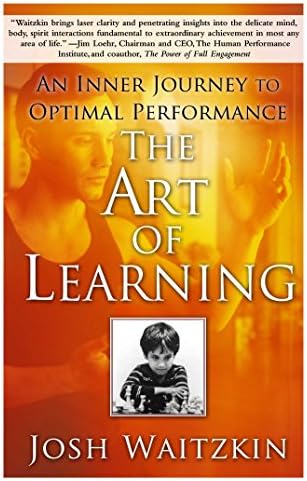
The Art of Learning & Living Life | Josh Waitzkin
The episode features Josh Waitzkin, former chess prodigy and subject of Searching for Bobby Fischer, now a performance coach working with elite competitors in finance, sports, and military. Andrew Huberman, professor of neurobiology at Stanford, explores Waitzkin's unique...

Episode


- 01
"Not taking on my weaknesses was outside of my conceptual scheme" - Josh, describing how being the target from age 6 forced constant self-improvement
- 02
"The most heartbreaking, devastating moments ultimately were the ones that catalyzed the most growth" - Josh on how major losses became his greatest teachers
- 03
"People who are at the pinnacles of different arts are often doing things that are much more similar than people in the same art at lower levels" - Josh on cross-disciplinary performance principles
- 04
"If you're not falling enough during a foil session, then you're not pushing your turns hard enough" - Josh on living at maximum stretch without snapping
- 05
"I drowned on the bottom of a pool for four and a half minutes after blacking out" - Josh on a near-death experience that catalyzed his move to Costa Rica
- 06
"The Gap between me at eight years old (1,800 ELO) and world champions is the same as world champions and the strongest AI engines (3,800+ ELO)" - Josh on AI's dominance in chess
- 07
"We're either practicing sloppiness or practicing quality. If we do something shitty, then we're practicing shitty" - Josh on quality as a way of life
Get the latest ideas from Huberman Lab.
Plus the best new takeaways about science from other top podcasts — read in minutes, not hours.
By continuing, you agree to podbrain's Terms and Privacy Policy.
These notes may contain occasional inaccuracies. Learn how podbrain notes are made
The episode features Josh Waitzkin, former chess prodigy and subject of Searching for Bobby Fischer, now a performance coach working with elite competitors in finance, sports, and military. Andrew Huberman, professor of neurobiology at Stanford, explores Waitzkin's unique approach to learning and performance optimization.
Waitzkin's journey spans chess mastery from age 6 to 23, world championships in Tai Chi push-hands, Brazilian jiu-jitsu training with Marcelo Garcia, and current high-performance foiling in Costa Rica. He has spent recent years coaching elite performers including the Boston Celtics and world-class investors.
The conversation examines pre-conscious versus post-conscious performance, the role of devastating losses in catalyzing growth, and how principles transfer across disciplines. Waitzkin shares his "MIQ" (Most Important Question) process and approaches to training that maximize quality over quantity.
Huberman and Waitzkin explore the neuroscience of learning, including how cold plunging affects adrenaline systems, how frame rate perception changes under stress, and why The Gap between conscious and unconscious processing drives creative breakthroughs.
Chess Prodigy Origins and Theory of Mind Development
Waitzkin discovered chess at age 6 in Washington Square Park, describing it as "wiping away the dust or cobwebs between me and something I had known very deeply at one point" - a feeling of rediscovering rather than learning something new.
His first teachers were Washington Square Park hustlers who taught tactical street chess and used "Jedi mind tricks of every sort," constantly messing with his mind and then teaching him what they were doing at progressively higher levels.
From age 7 to 23, Waitzkin was consistently top-rated for his age in the US, living "in a pressure cooker of competition" where "any mistake you make, my rivals and their coaches who are strong masters and international masters and grandmasters would be able to study."
"Not taking on my weaknesses was outside of my conceptual scheme" - Josh, explaining how being the constant target forced him to address every weakness immediately or experience pain in competition.
Huberman notes this created "a hypertrophy set of circuits for theory of mind" - developing advanced ability to understand opponents' psychology and strategy from an extremely young age, opposite of autism spectrum patterns.
The Movie, Loss of Self-Expression, and Existential Crisis
When Searching for Bobby Fischer was released at age 15, Waitzkin experienced "all the attention, the media, cameras everywhere, groupies, all the temptations" which became "a really alienating period for me relative to chess."
A Russian coach urged him to study players opposite to his aggressive style, asking "what would Karpov play here?" instead of "what does Josh feel here?" - moving him away from self-expression toward imitation.
"The combination of that public eye and then the movement away from my self-expression led to a period of obstructedness and self-consciousness" - Josh, describing the transition from pre-conscious to post-conscious competition.
After high school at 18, Waitzkin left the US to study East Asian Philosophy and meditation, making chess "much more of an introspective process" where "chess became connected to life."
At 19, training at the Human Performance Institute, Waitzkin had a conversation with NFL quarterback Jim Harbaugh that crystallized a key insight: "holy shit, this guy's an NFL quarterback and I'm this crazy chess player, but we're doing the same thing."
The 1994 World Championship Loss That Changed Everything
At 17, Waitzkin played Peter Svidler for the under-18 world championship in Szeged, Hungary. Svidler offered a draw at move 12 in a critical position, creating psychological pressure to release tension.
"The urge to release psychological tension often leads to the decision to release chess tension in the chess pieces. And when you release chess tension, usually the person who releases the tension will be on the wrong side of tactics" - Josh on chess psychology.
Waitzkin declined the draw and made "a slightly overaggressive move" that led to defeat. He didn't study the loss for two and a half months because "it was so painful to me."
When he finally analyzed the position, he realized the winning move required "harnessing the power of empty space against aggression" - removing his last defensive piece because "his attack needed my defense like fire needs fuel to burn."
Years later, this same principle of utilizing empty space against aggression became how Waitzkin won the 2004 Tai Chi push-hands World Championship against a bigger, stronger opponent who had trained since childhood.
Transition to Martial Arts and Thematic Interconnectedness
At a simultaneous chess exhibition years after quitting competitive play, Waitzkin realized "I wasn't playing chess. I was moving chess pieces but I was thinking in tai chi language... feeling flow, feeling space left behind, riding energetic waves of the game."
Waitzkin trained with Marcelo Garcia, "perhaps the greatest grappler, pound for pound to ever live" and nine-time world champion. They own a school together in New York.
While training for Brazilian jiu-jitsu world championships, Waitzkin ruptured his L4-L5 disc. After training for another year and a half with the injury, doctors told him "I had to let this one go or I'd be crippled for life."
"I wanted to take on the challenge of loving training others with the same intensity that I love training myself" - Josh, describing his transition to coaching after the injury forced him from competition.
Waitzkin now trains 3-5 hours daily in foiling in Costa Rica's jungles, maintaining his "really intense training lifestyle" while coaching elite performers globally.
The MIQ Process and Day Architecture
The MIQ (Most Important Question) process involves identifying the most critical question at day's end "with full intensity in a peak performance state," then releasing it completely and returning to it first thing in the morning pre-input.
"You're systematically opening up the channel between the conscious and the unconscious mind. You're feeding critical questions to the unconscious, which is processing overnight" - Josh on the MIQ mechanism.
Waitzkin experimented with studying chess "from everywhere between 45 minutes a day to 16 hours a day" and found the sweet spot was "about four and a half hours a day" at "a 10 out of 10, like fucking just on fire."
"The rest of the day became about cultivating those four and a half hours" - Josh, emphasizing that peak creative output requires deliberate recovery and preparation periods.
Micro-applications throughout the day: "Instead of checking your phone while taking a piss, you pose yourself an MIQ, you release it, you do not do anything but piss in the bathroom and breathe and then return to the question and you'll have an insight."
MIQ gap analysis tracks how understanding evolves over days or weeks of studying a problem, revealing patterns in thinking that become "game tape" for mental athletes who lack physical video to review.
Living on the Other Side of Pain and Quality as Practice
"Living on the other side of pain" means embracing mental discomfort, physical discomfort, confronting issues one doesn't want to think about, and taking on cognitive bias patterns as forms of deliberate practice.
Waitzkin practices cold plunging (34-degree water for extended periods) not by "gritting our teeth and hating it" but by learning to "love the fact that we're about to suffer in that cold water."
"If you're not falling enough during a foil session, then you're not pushing your turns hard enough" - Josh on the principle that constant success means insufficient challenge.
Taking on weaknesses through strengths: "You can learn Karpov through Kasparov" - learning defensive chess through the lens of aggressive players rather than abandoning one's natural style.
"We're either practicing sloppiness or practicing quality. If we do something shitty, then we're practicing shitty" - Josh on how thematic interconnectedness works both positively and negatively across all life domains.
Waitzkin often addresses themes in areas where people are "much less calloused" - for example, working on a poker player's control issues at home rather than at the poker table where they've built defenses.
Frame Rate, Arousal States, and the Neuroscience of Performance
During a fight where Waitzkin broke his hand, "instantly time slowed down and he was moving in slow motion and I was able to just so easily play with someone with a broken hand compared to what had been a war before."
Huberman explains that elevated arousal increases frame rate (experiencing time in finer slices) and narrows visual aperture, while relaxation does the opposite - and the visual system can drive arousal bidirectionally.
Marcelo Garcia is "known as the king of the scramble" because he "spends his whole time in transition" - always moving rather than holding positions, training in the "in-between" where most people don't look.
"If you spend your life training in the in-between, then you have more frames than other people do" - Josh on how training in transitions creates perceptual advantages in competition.
Waitzkin experienced an earthquake during a world chess championship while deep in calculation: "I experienced the earthquake from inside of the chess position" and found the solution by surfacing from the complexity.
To minimize chess blunders: "Decide, write it down, and then make the move" rather than decide and immediately move - the writing creates a "resurfacing" moment that prevents obvious mistakes.
Pre-Conscious vs Post-Conscious Performance and Ego
Pre-conscious performance is characterized by "naivete," "freedom," "playfulness," and "lack of awareness of my own mutability" - performing without reflection on mortality, absurdity, or external expectations.
The tunnel to post-conscious performance is triggered by events like near-death experiences, heartbreak, existential reflection, or achieving a major goal - anything that creates self-awareness and complexity.
"Most people are locked up" in the tunnel between pre-conscious and post-conscious states, "underperforming where they were when they were more naive" - unable to return to freedom while carrying new knowledge.
Post-conscious performance is "not a return to the preconscious state" but "an integration of one's mortality, of the existential absurdity into one's consciousness, and then a discovery of a deeper sense of liberation."
"Fearlessness isn't a thing. It's how one works with fear" - Josh, noting that great Navy SEALs and MMA fighters aren't without fear but have learned to work with it rather than being afraid of being afraid.
On ego: "When people say someone is low ego, they don't actually mean they're low ego. They mean they have a sound egoic structure" - not leaking insecurity constantly.
"You want to be able to be like water and be like a mountain" - Josh's synthesis of ego, describing the ability to have both fluid adaptability and unbreakable will.
Near-Death Experience and Life in Costa Rica
Waitzkin drowned doing hypoxic breath work at NYU pool, remaining on the bottom for four and a half minutes after blacking out. An elderly man timed his laps and pulled Waitzkin out after the fourth lap.
"I should be dead or brain damaged in a big way" - Josh, noting he was unconscious for 25 minutes total and spent the night testing his memory of chess variations to check for brain damage.
The drowning was caused by flushing CO2 through hyperventilation, which eliminated the urge to breathe. Huberman emphasizes: "Carbon dioxide is the trigger for the gas reflex" - without it, you feel peaceful until blackout.
"I emerged with more of a commitment... to live life as truly and beautifully and authentically as conceivable. And then soon after, we moved to the jungle" - Josh on how the near-death experience catalyzed major life changes.
Waitzkin now lives in Costa Rica's jungles with his family, training 3-5 hours daily in foiling while working remotely with elite performers globally, including recent work with the Boston Celtics.
AI, Chess Engines, and Lila Science Project
The ELO rating gap between 8-year-old Waitzkin (1,800) and world champions (2,800-2,900) equals The Gap between world champions and strongest AI engines (3,800+) - "we are the ants now."
Chess engines and AI changed who chess players are because "you can have the answer right away versus having to sit in cognitive and emotional dissonance for sometimes weeks or months at a time without knowing the answer."
Waitzkin co-founded Lila Science with Jeff Van Maltzeln, Chris Fussell (former Navy SEAL who ran JSOC), and Jack Millwood to create "AI science factories where the entire scientific process can be replicated."
The project aims to create "scientific super intelligence" that can pose hypotheses, isolate variables, test, provide feedback, and iterate continuously - like AlphaZero's approach applied to scientific discovery.
"I really don't think it matters if humans are all living for 150, 200 years if we have no climate to live on" - Josh on why material science innovations for climate crisis matter most to him personally.
Waitzkin emphasizes that safety is prioritized first, contrasting with other AI companies, and that the team would not "push the button" on something potentially harmful to humanity even if it satisfied all their dreams.
Coaching Philosophy and Working with Elite Performers
"I don't like solving for motivation. That's one thing" - Josh, explaining he works with people who are already all-in and want to take themselves on rather than those who need motivating.
Joe Mazzulla, head coach of the Boston Celtics, is "one of the best I've ever seen at turning weaknesses into strengths" - not just making them less weak but "turning like an area of core weakness into a core power zone."
"99.9% listening, observing, not doing" - Josh on coaching virtuosos, noting that coaches often do too much because "they need to show that they're valuable" rather than understanding the complex entanglement of genius and dysfunction.
Marcelo Garcia never missed a Monday training session after winning major competitions on Sunday - embodying "dynamic quality and humility and a way of life" by immediately returning to practice.
After winning 2005 ADCC with an innovative repertoire, Marcelo "shed the entire repertoire" the next Monday and created "a whole new repertoire" for the next championship two years later - "shedding the snakeskin."
"Leading with vulnerability is such an exquisite" quality - Josh on how both Joe Mazzulla and Sean McVay (LA Rams coach) lead by taking themselves on more intensely than anything while being authentic about their struggles.
Practical Tools: Cold Plunging, Contrast Training, and Recovery
Waitzkin practiced very long cold plunges (36-degree water for 11-12 minutes) for years, noting "11 minutes is so different from nine minutes" in terms of difficulty and mental challenge.
Current practice involves 3-4 rounds of contrast training between 42-44 degree water and sauna, with one longer plunge weekly rather than daily extended sessions.
Huberman emphasizes cold plunging early in the day increases adrenaline, noradrenaline, dopamine, and cortisol, which "the better you're gonna sleep at night" by setting circadian rhythm around morning arousal.
"The more adrenaline, epinephrine, noradrenaline, and dopamine that you experience early in the day... the better you're gonna sleep at night" - Huberman on the importance of morning arousal for evening parasympathetic dominance.
Waitzkin thinks in terms of "walls of adrenaline" during cold plunging rather than time, learning to feel the deployment of adrenaline and watching frame rate changes as each wall passes.
"Is there a better sleep hack?" - Huberman asks about cold plunging's sleep benefits, with both agreeing it's among the most powerful non-pharmacological interventions for sleep quality.




These notes may contain occasional inaccuracies. Learn how podbrain notes are made
More in Health & Wellness

The Mental Frame & Specific Daily Actions to Succeed | Andy Stumpf
Jun 15, 2026
#396 ‒ Breast cancer screening: understanding risk, deciding when to start and how often to screen, and choosing the right imaging strategy
Jun 15, 2026
Essentials: Sleep Toolkit for Optimizing Sleep & Sleep-Wake Timing
Jun 11, 2026
Everything Women Need to Know About Perimenopause, Menopause & Hormone Therapy - Compilation
Jun 11, 2026
You Can Get What You Want.... But There’s a Catch
May 21, 2026

.svg)