
Ben Horowitz - Backing America’s Future - [Invest Like the Best, EP.457]
Ben Horowitz, co-founder of Andreessen Horowitz, joins Patrick O'Shaughnessy to discuss America's competitive position in the AI era and the firm's mission to maintain technological leadership. Horowitz brings unique perspective from his operating experience and mentorship under Intel CEO Andy Grove, whose...

Episode
![Invest Like the Best with Patrick O'Shaughnessy episode thumbnail: Ben Horowitz - Backing America’s Future - [Invest Like the Best, EP.457]](https://podbrain.gumlet.io/storage/v1/object/public/thumbnails/taddy-f6ee2240-ef52-41f8-8704-93d9fa693d51.webp?w=1200&h=630&mode=fill&q=85&format=auto)
- 01
AI deployment requires no new infrastructure unlike past technologies - "The internet is here. So if you want to use AI, you just do it" - Ben
- 02
America's tech competitiveness remains strong due to entrepreneurship culture that values "succeeding, doing something larger than yourself, making the world a better place" - Ben
- 03
Bad government policy could derail AI leadership: "We were that close to being basically out of the global chip game" with GPU approval requirements - Ben
- 04
Las Vegas Police Department's AI program reduced crime over 50% and police shootings 75% through drone deployment and AI cameras - Ben
- 05
Only 40 AI researchers globally can build giant models: "If you haven't been at Google or Facebook or OpenAI... you probably don't know how to do it" - Ben
- 06
Venture capital laws of physics changed - "you cannot throw money at the problem" no longer applies with sufficient data and GPUs - Ben
- 07
Culture must be defined as specific behaviors, not platitudes: "$10 a minute" fines for being late to entrepreneur meetings enforces respect - Ben
- 08
Technology solutions work better than policy solutions: "defund the police did not make anybody safer, but technology does" - Ben
Get the latest ideas from Invest Like the Best with Patrick O'Shaughnessy.
Plus the best new takeaways about artificial intelligence from other top podcasts — read in minutes, not hours.
By continuing, you agree to podbrain's Terms and Privacy Policy.
These notes may contain occasional inaccuracies. Learn how podbrain notes are made
Ben Horowitz, co-founder of Andreessen Horowitz, joins Patrick O'Shaughnessy to discuss America's competitive position in the AI era and the firm's mission to maintain technological leadership. Horowitz brings unique perspective from his operating experience and mentorship under Intel CEO Andy Grove, whose High Output Management profoundly influenced his approach to leadership.
The conversation covers America's entrepreneurship advantages, the changing dynamics of venture capital in the AI age, and Horowitz's personal funding of advanced police technology in Las Vegas. Horowitz reflects on lessons from his father, a former communist turned conservative, and his friendship with rapper Nas, while explaining how The Hard Thing About Hard Things emerged from Grove's management philosophy.
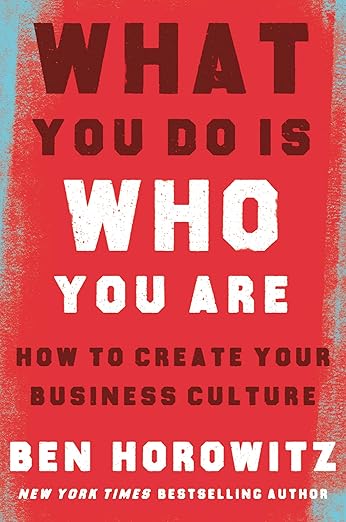
Key topics include the fragility of America's tech dominance, the democratizing effects of AI, and how Andreessen Horowitz built a new model for venture capital by focusing on entrepreneur support rather than traditional reputation-based investing. Horowitz also discusses culture building, drawing from his book What You Do Is Who You Are to explain how behaviors define organizational identity.
America's AI Leadership and Competitive Threats
America's tech competitiveness remains exceptional due to entrepreneurship culture where "succeeding, doing something larger than yourself, making the world a better place" are values young people embrace, unlike Europe where regulatory burdens and cultural challenges limit startup formation.
Policy represents the biggest threat to AI dominance: "a bad government, no matter how many smart people you have, no matter how great a culture you have, can ruin the whole thing" - citing Venezuela's decline from fourth richest country to economic collapse under communism.
The Biden administration's executive order requiring federal approval for GPU sales nearly eliminated America from "the global chip game" before being reversed, demonstrating policy fragility.
AI deployment requires no new infrastructure unlike past technologies: "For cars, you needed things like roads, traffic lights... for the internet, you needed fiber in the ground and people to have smartphones. The internet is here. So if you want to use AI, you just do it."
The Scarcity of AI Talent and Changing Investment Dynamics
Only approximately 40 people globally can build giant AI models: "If you haven't been at Google or Facebook or OpenAI or Anthropic... you probably don't know how to do it because you can't learn it in school" due to the "alchemistic" nature of the work.
Traditional venture capital laws changed: "you cannot throw money at the problem" no longer applies - "if you have the data and you have enough GPUs, you can solve damn near anything," as demonstrated by Elon Musk's rapid AI model development.
AI companies achieve unprecedented revenue growth speeds, with examples like Cursor reaching "over a billion dollars in revenue in no time" compared to traditional IDEs taking "12 or 15 years to get" to much smaller scale.
Market sizes could be "$5 trillion" instead of traditional "$50 billion" assumptions, requiring new frameworks for valuation and long-term value calculations.
Building Andreessen Horowitz: From Startup to Institution
No new top-tier venture firms had emerged since Benchmark in 1995, creating an opportunity gap: "if you're not top tier in VC, you're not going to last because in a super hot period, everybody makes money."
The founding strategy focused on building "a better product for entrepreneurs" rather than competing on traditional reputation-based metrics, addressing founder needs for "confidence," "knowledge," "know-how," and "network."
Marketing differentiation emerged because "VCs didn't ever market themselves at all" - naming the firm after themselves solved LP concerns about founders leaving: "you guys are really good entrepreneurs. You're just going to leave this thing and go build another company."
Fund One's success with Skype, Slack, Okta, and Stripe in a "$300 million fund" established credibility, though "Fund two wasn't as good as one" before Fund Three's recovery with Coinbase, Databricks, Lyft, and GitHub.
Management Lessons from Andy Grove and Intel
Andy Grove's High Output Management became Horowitz's "favorite book" and inspired The Hard Thing About Hard Things as "the updated version of it," focusing on management's psychological difficulties rather than conceptual simplicity.
Grove's confrontational management style demonstrated through his Santa Clara facility story: bringing "a roll of toilet paper" to meetings and demanding "when the fuck you're going to be up to code" achieved results in "two months."
The hardest management challenge is reorganizations because "you're redistributing power" and "somebody who's really good, who you've had for a long time, is going to lose power and they're going to be fucking pissed."
Founder failure patterns emerge from hesitation after mistakes: "you lose confidence. And that leads you to hesitate. That hesitation is what causes the failure mode" as companies become indecisive or overly democratic.
Culture as Behavior: Lessons from Samurai Philosophy
Drawing from What You Do Is Who You Are, culture must be "a set of actions" rather than abstract values: "if you define your culture as a kind of set of ideas, integrity, do the right thing... it's actually just a bunch of fucking platitudes."
Specific behavioral requirements include response time SLAs, punctuality standards, and "$10 a minute" fines for being late to entrepreneur meetings to enforce respect.
The "dream builders" philosophy prohibits making entrepreneurs "look bad" to enhance personal reputation: "if you try to make yourself look good by making an entrepreneur look bad, you're fired."
Every employee must "sign the culture document" and receive "an hour" of culture training from Horowitz personally, with enforcement mechanisms including post-meeting surveys with entrepreneurs.
Las Vegas Police Technology Initiative
Las Vegas Police achieved a "94%" murder clearance rate compared to San Francisco's much lower rate through community policing: "when somebody is murdered, there's always somebody who knows who did it. They just don't talk to the police... but they talk to us because we're part of the community."
Horowitz personally funded comprehensive technology deployment including drones, AI cameras, and Prepared 911 systems: "If a 911 call comes in or if a gunshot goes off, there will be a drone deployed in there within 90 seconds."
Results showed "crime is down over 50%" and "shooting of suspects by police is down close to 75%" since program implementation, making "everybody safer."
AI cameras eliminate dangerous misidentifications: instead of "2004 Hyundai that's blue" descriptions leading to wrong-car stops, "we know that's the car" and "there's a baby in the car," enabling safer apprehensions.


These notes may contain occasional inaccuracies. Learn how podbrain notes are made
More in Finance & Business

The Biggest Pivot In AI History Is Happening Right Now | Jordi Visser
Jun 20, 2026
How Substack Creators Are Covering This Strange Markets Era
Jun 20, 2026
#422 Joseph Pulitzer
Jun 20, 2026
World's First Trillionaire, Anthropic Fable Banned, The New Oligarchs, Iran Peace Deal
Jun 19, 2026Anthropic's Co-Founder and Top Economist on Doing Research at the AI Frontier
Jun 19, 2026
HIGHLIGHTS: Sridhar Ramaswamy - CEO of Snowflake
Jun 19, 2026
More episodes with Ben
Ben Horowitz On What Makes a Great Founder
Ben Horowitz: RSI, Crypto as AI Money, & Classified Physics
David Solomon & Ben Horowitz on Building Organizational Resilience & Navigating Macro Uncertainty
Ben Horowitz and Balaji Srinivasan on Netscape and Network States
The Hidden Economics Powering AI
.svg)