
#422 Joseph Pulitzer
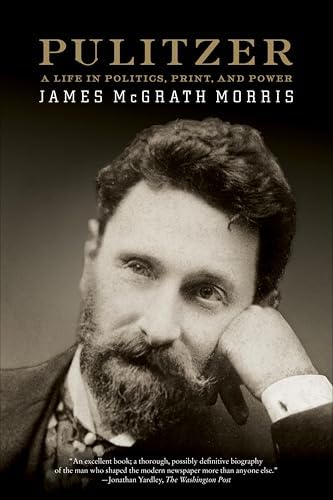
This episode is a solo deep-dive by the host into Pulitzer A Life in Politics, Print, and Power by James McGrath Morris, a biography of Joseph Pulitzer — the Hungarian immigrant who transformed American journalism into a medium of mass consumption and became...

Episode


- 01
Pulitzer arrived in America at 18 with no money, no language, and no connections — within two decades he became one of the 20 wealthiest people in the country.
- 02
His St. Louis Post-Dispatch generated $88,000 annually at a time when the average skilled worker earned $600 a year working six days a week.
- 03
Pulitzer's daily management ritual never changed: exact copies printed, sold, returned, advertising lines run, and every expense category — 'his thirst for details was insatiable.'
- 04
He raised over $100,000 for the Statue of Liberty pedestal through early mass crowdfunding, printing every donor's name in The World — circulation soared as a result.
- 05
Going blind in his early 40s at the apex of his power, Pulitzer described the loss as '10 times, honestly 50 times' more suffering than all the rest of his life combined.
- 06
Pulitzer's formula: 'The headline was the lure and the copy was the hook' — stories written so simply anyone could read them, so colorfully no one would forget them.
- 07
'Simply put, Pulitzer was a Democrat in politics but a despot in the office' — he publicly championed labor while firing workers who tried to unionize his own paper.
- 08
His son wrote to him: 'One of the strange differences between us two is the fact that you have never come near learning how to enjoy life.'
Get the latest ideas from Founders Podcast.
Plus the best new takeaways from other top podcasts — read in minutes, not hours.
By continuing, you agree to podbrain's Terms and Privacy Policy.
These notes may contain occasional inaccuracies. Learn how podbrain notes are made
This episode is a solo deep-dive by the host into Pulitzer A Life in Politics, Print, and Power by James McGrath Morris, a biography of Joseph Pulitzer — the Hungarian immigrant who transformed American journalism into a medium of mass consumption and became one of the most powerful media figures of the 19th century.
The episode traces Pulitzer's full arc: from orphaned teenager who lost seven of eight siblings and his father by age 13, to Civil War soldier paid $135 to fight for strangers, to St. Louis newspaper publisher, to owner of the most widely read newspaper in American history. Along the way, the host draws on insights from Poor Charlie's Almanack and Zero to One to frame Pulitzer's business instincts and relentless focus.
The second half of the episode covers the cautionary dimension of Pulitzer's story — his descent into blindness, chronic pain, noise sensitivity, isolation, and psychological torment during the final two decades of his life, ending with a portrait of a man who built an empire but never learned to enjoy it.
From Hungarian Orphan to Civil War Mercenary
By age 13, Pulitzer had experienced the deaths of his father and seven of his eight siblings. His father died of tuberculosis at 47, plunging the family into bankruptcy — their property seized within six months for failure to pay taxes.
At 17, Pulitzer's escape route was the American Civil War. Wealthy Bostonians were paying European recruits' passage to America to fill military quotas — soldiers were dying at 13,000 a month. Pulitzer survived and was paid $135.35 at the war's end.
Released into record unemployment alongside thousands of other veterans, Pulitzer showed early strategic thinking: 'Everybody's in New York doing the exact same thing. I should find a different city.' He chose St. Louis for its large German-speaking population.
His early jobs included mule caretaker, riverboat worker, construction laborer, and waiter — the waiter stint ending when a rejected beefsteak 'found itself dropped onto the head of the guest rather than onto his plate.'
The Library, the Mentors, and the First Newspaper Job
Pulitzer invested his meager savings into subscription library membership, spending every free moment there — 'often bringing a pair of apples for sustenance so as not to waste a moment leaving the library for a meal.' The library held 27,000 books and newspapers from across the country.
As described in Poor Charlie's Almanack, Charlie Munger cites 'Carlyle's prescription' — devoting 98% of attention to the task directly in front of you rather than vague future possibilities. Pulitzer embodied this principle throughout his career, attacking every job with total focus.
The president of the German Immigration Aid Society, who had observed Pulitzer's diligence firsthand, also owned a newspaper — the Westliche Post. This connection landed Pulitzer his first reporting job at age 20.
'He was so industrious that he became a positive annoyance to others who felt less inclined to work.' His editors noted: 'I never called on him at any hour that he did not immediately respond.'
Pulitzer immediately recognized journalism as his calling: 'To be a newspaper editor was to do more than report on the world. It was to shape it.' Older, successful visitors to the paper noted: 'That young fellow possesses great dialectical ability. I know it, for I have felt it.'
Pistols, Politics, and the Perils of a Fiery Temper
Pulitzer's volcanic temper was a lifelong liability. As a young reporter-turned-legislator, he drew a pistol and fired twice at a 300-pound lobbyist named Augustine after an exchange of insults — missing with the first shot, grazing the leg with the second.
He was indicted for felonious assault, stood trial, and escaped with a small fine by claiming self-defense. A mentor had warned him years earlier: 'He must become more conservative and forbearing for fear that he might someday meet a person like himself, and then there would be trouble.'
In only five years, Pulitzer had gone 'from a bounty-hunting Hungarian teenager to an American lawmaker,' simultaneously holding positions as both legislator and journalist — using his reporting to advance his political work.
Pulitzer understood media silence as a weapon: when he didn't want attention on something, he met it with silence rather than rebuttal, knowing 'the public's attention will move forward quickly.'
Building the St. Louis Empire: Auctions, Mergers, and Insider Edge
At 25, Pulitzer borrowed $5,000 to buy into the Westliche Post. Within a year, a falling out with his mentors led them to buy him out for $30,000 — six times his investment in twelve months, equivalent to fifty years of wages for a skilled worker.
He then bought a failing German-language paper at auction for a modest sum — not for the paper itself, but for its Associated Press membership, which gave newspapers exclusive access to national and international news. He flipped the AP membership to the St. Louis Globe for $20,000 within 48 hours.
Pulitzer's core competitive edge, as with James J. Hill in railroads (cited in Poor Charlie's Almanack as one of history's greatest business operators), was that he came from inside the industry: 'Those who own newspapers scarcely ever make them. The persons who do own them are scarcely fit to write the smallest and most unimportant part of the paper.'
When buying the Dispatch at bankruptcy auction, and again when acquiring the Evening Star, Pulitzer used a 'Trojan horse' — a hired bidder — to prevent competitors from realizing he saw hidden value and driving up the price.
His daily management ritual at the Post-Dispatch was relentless and never changed for the rest of his life: exact copies printed, sold, and returned; advertising lines run that day, that week, year-to-date; staff costs, paper costs, telegraph costs, and total revenue — all demanded every single morning.
The St. Louis Post-Dispatch generated $88,000 annually for Pulitzer alone — at a time when the average skilled worker earned $600 a year. He owned 100% of the paper.
Conquering New York: The World Becomes the World's Biggest Paper
Pulitzer bought the New York World from Jay Gould — who 'never cared anything about the paper' — for nearly $500,000 in debt. The paper had an anemic circulation of 15,000 and was losing money every week.
He immediately raided his own brother Albert's newspaper staff — his 'three most valuable men' — to staff The World. Albert said: 'This was a blow that was intended to kill me.' Joseph's response was purely competitive: 'In a city teeming with editorial talent, Joseph had chosen to raid his brother's shop.'
Pulitzer's editorial formula, as described in Pulitzer A Life in Politics, Print, and Power, was precise: 'The headline was the lure and the copy was the hook.' Stories written simply enough for anyone to read, colorfully enough that no one would forget them. Vagueness was 'a sin' — a tall man was '6 foot 2 inches tall,' not just 'tall.'
He paid a gifted cartoonist more than twice the salary of his reporters, understanding that images were essential for differentiation on newsstands where 'the gray, unbroken front pages of the city's newspapers were indistinguishable from each other.'
Pulitzer ran an early mass crowdfunding campaign to fund the Statue of Liberty pedestal — printing every donor's name in The World regardless of amount. Over 120,000 people donated, raising over $100,000 in under five months. Circulation soared.
Peter Thiel writes in Zero to One that 'the single most powerful pattern I have noticed is that successful people find value in unexpected places, and they do this by thinking about business from first principles instead of formulas.' Pulitzer's entire career — from AP membership arbitrage to evening newspaper bets to crowdfunding — exemplifies this principle.
William Randolph Hearst, 24 years old and backed by his father's wealth, explicitly set out to build 'a West Coast version of Joseph Pulitzer's The World' — eventually bringing the circulation war back to New York and challenging Pulitzer on his own turf.
Blindness, Isolation, and the Tragedy of the Final Decades
In his early 40s, at the apex of his power, Pulitzer's retina detached in his right eye and the left was in danger. The prognosis: 'The natural course of the disease is slowly but surely progressive, leading finally to total blindness.' He later said: 'That was the beginning of the end.'
He developed extreme sensitivity to noise alongside his blindness, and the book describes his final two decades as: 'A giant intelligence eternally condemned to the darkest of dungeons, a caged eagle furiously belaboring the bars.'
Despite never returning to the office, Pulitzer continued running The World through hundreds — possibly thousands — of telegrams per week, dictating and receiving all correspondence by ear. He kept vast amounts of operational detail in his memory.
Pulitzer described the loss of reading as: 'This represents more suffering than all the rest of my life brought me. 10 times as much. I honestly think 50 times as much — to the point where I cannot even finish this sentence.'
The hotel lobby where he had once been kicked out as a homeless young man — he bought it 23 years later. 'The former derelict getting kicked out of the lobby now owned the place.'
His son wrote to him directly: 'One of the strange differences between us two is the fact that you have never come near learning how to enjoy life.' His wife Kate, after 25 years of marriage spent largely apart, wrote: 'What does it all amount to? To a puff of smoke which makes a few rings and then disappears into nothingness.'
The book ends as a cautionary tale: 'Pulitzer was bereft of friends, and the companions with whom he spent his days were paid to be with him.' He was estranged from his only living sibling, disappointed in his children, and had spurned his wife's companionship so often she had stopped offering it.


These notes may contain occasional inaccuracies. Learn how podbrain notes are made
More in Finance & Business

The Biggest Pivot In AI History Is Happening Right Now | Jordi Visser
Jun 20, 2026
How Substack Creators Are Covering This Strange Markets Era
Jun 20, 2026
World's First Trillionaire, Anthropic Fable Banned, The New Oligarchs, Iran Peace Deal
Jun 19, 2026Anthropic's Co-Founder and Top Economist on Doing Research at the AI Frontier
Jun 19, 2026
HIGHLIGHTS: Sridhar Ramaswamy - CEO of Snowflake
Jun 19, 2026
.svg)