
Rich People Buy Differently (So Price Like It) | Ep 949
Alex Hormozi, founder of acquisition.com with a portfolio generating over $250 million annually, breaks down the mathematics of wealth distribution and its implications for business pricing strategy. His recent book launch achieved $106 million in weekend sales, setting a Guinness world record for fastest-selling...

Episode


- 01
The top 1% of Americans control $32 out of every $100 in wealth - more than the bottom 90% combined
- 02
Alex Hormozi's book launch generated $106 million in weekend sales, breaking a Guinness world record for fastest-selling nonfiction book
- 03
For effective upsells, multiply your price by 5-10X and expect only 20% of customers to purchase at that tier
- 04
One customer paying $10,000 for a $2,000 service equals 400 customers buying a $50 service that costs $25 to deliver
- 05
When Hormozi raised his gym consulting price from $500 to $6,000, close rates actually increased because prospects believed higher prices meant better quality
- 06
Rich customers think 'for what?' when hearing prices, while poor customers immediately react 'that's expensive' without considering value
- 07
Tesla's top-down pricing strategy started with $250,000 Roadsters before moving to mass-market Model 3s, creating stronger brand positioning
- 08
If you're closing 80% of prospects, you likely have 3-4X pricing power sitting on the table untapped
Get the latest ideas from Alex Hormozi.
Plus the best new takeaways about wealth building from other top podcasts — read in minutes, not hours.
By continuing, you agree to podbrain's Terms and Privacy Policy.
These notes may contain occasional inaccuracies. Learn how podbrain notes are made
Alex Hormozi, founder of acquisition.com with a portfolio generating over $250 million annually, breaks down the mathematics of wealth distribution and its implications for business pricing strategy. His recent book launch achieved $106 million in weekend sales, setting a Guinness world record for fastest-selling nonfiction book.
The discussion centers on why most entrepreneurs fail to capture available wealth by pricing too low and targeting customers without spending power. Hormozi uses detailed wealth distribution data to demonstrate that the top 10% of Americans control 69% of all wealth, with the top 1% alone holding more than the bottom 90% combined.
Drawing from his experience scaling from $500 gym memberships to $135,000 consulting packages, Hormozi explains the Pareto Principle's application to pricing tiers and customer segmentation. He shares the pivotal moment when he accidentally discovered high-ticket sales by pricing a service at $6,000 expecting rejection, only to close $60,000 in a single day.
The conversation covers practical implementation strategies including Tesla's top-down market approach, psychological pricing anchors, and how to identify optimal price points based on close rates. Hormozi references concepts from his $100M Offers book regarding commodity differentiation and creating offers in distinct categories that justify premium pricing.
The Shocking Reality of American Wealth Distribution
Using $163 trillion in U.S. household net worth as $100 distributed among 100 people, the bottom 50% would have just $2.50 total
The next 40% of Americans would control $28, while the top 9% would hold $38 of the theoretical $100
The top 1% alone controls $32 - more wealth than the bottom 90% of Americans combined, demonstrating extreme concentration of purchasing power
"If you want to make money, go where the money is" - Hormozi emphasizes that 69% of all wealth sits in just the top 10% of the population
Pareto's Principle Applied to Business Pricing Strategy
The 80/20 rule compounds: 20% of customers generate 80% of revenue, but within that 80%, 64% comes from just 4% of total customers
Of the 64% profit from top customers, 51% comes from just the top 1% of all customers, mirroring wealth distribution patterns
"The only thing worse than offering a $1,000 thing to somebody who's got a $100 budget is offering a $100 thing to somebody who's got $1,000 budget" - Hormozi on pricing misalignment
Single high-value customers often don't cost proportionally more to serve, making them significantly more profitable than multiple low-value customers
Tesla's Top-Down Market Strategy as Business Blueprint
Tesla started with $250,000 Roadsters in limited production before moving to Model S, then mass-market Model 3, working systematically downmarket
Top-down branding creates stronger narrative: "I made an expensive car, now here's a more affordable version" versus "I'm a budget brand making expensive cars"
Starting with unscalable, high-touch services for wealthy customers is operationally easier than building mass-market automation from scratch
Wealthy customers are proportionally less demanding - $100,000 represents 1% of a $10 million net worth versus 10% for someone with $1,000
The 5-10X Pricing Rule for Effective Upsells
Hormozi's rule: multiply base price by 5-10X for each tier, expecting 20% uptake at each level rather than incremental increases
Example: 800 customers at $10/month plus 200 at $100/month doubles revenue, with the premium tier contributing disproportionate profit
His own business demonstrates this: School at $100/month, L1 at $5,000, L2 at $35,000, L3 at $135,000, following the 5-10X pattern
"People will have these, I'll go 100 and 129. It's like it's the same pitch, it's the same price" - criticizing minimal price differences that don't reflect buyer segments
Hormozi's $60,000 Day: The Accidental Discovery of High-Ticket Sales
Transitioning from $500 gym training packages, Hormozi priced a consulting service at $6,000 expecting rejection, but the prospect immediately agreed
"I said, $6,000. So for me, it was a 12X compared to the price that I was used to selling at. And I just said it. So I was like, he's just going to say nope" - Hormozi on his pricing breakthrough
By day's end, he had closed $60,000 across eight calls, escalating prices from $6,000 to $10,000 as confidence grew
"That was the moment where I elevated. That was the moment where my life really changed" - describing the transformative impact of discovering high-ticket pricing
Psychology of Rich vs Poor Buying Behavior
Poor customers react to price with "that's expensive" while rich customers ask "for what?" - focusing on value rather than absolute cost
Wealthy shoppers sort products from high to low price, looking at premium options first because "that's probably the stuff that's for them"
Rich customers want three things: fast, easy, and guaranteed results, willing to pay premium for convenience and certainty
"If you sell to rich people long enough, they will make you one of them" - describing the wealth-building effect of serving affluent customers
Close Rate Analysis and Pricing Optimization
80% close rates indicate 3-4X pricing power available; 60-80% suggests 2-3X potential; 30-40% represents appropriate pricing
When Hormozi raised a health company's price 50% after recommending 100% increase, close rates actually improved because prospects gained confidence in the service
Lead optimization example: $5 leads worth $20 (4X return) versus $17 leads worth $189 (11X return) - quality over quantity in customer acquisition
"You can't judge whether you're priced appropriately by people who can never pay it to begin with" - on avoiding feedback from non-target customers
Avoiding Commodity Competition Through Strategic Differentiation
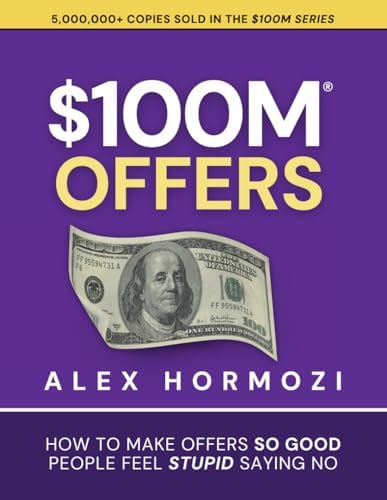
As explained in $100M Offers, the first chapter addresses selling commodities - when customers can reasonably compare your product to competitors and choose based on price alone
"The idea is that we want to price our things so high and be in such a clearly different category that people say these two things must be different"
Premium pricing signals quality and capability - B2B customers assume $1,500/month services can't handle enterprise needs compared to $20,000/month alternatives
Higher prices enable better talent acquisition, superior service delivery, enhanced reputation, and increased demand - creating a virtuous cycle of business growth
These notes may contain occasional inaccuracies. Learn how podbrain notes are made
More in Finance & Business

The Biggest Pivot In AI History Is Happening Right Now | Jordi Visser
Jun 20, 2026
How Substack Creators Are Covering This Strange Markets Era
Jun 20, 2026
#422 Joseph Pulitzer
Jun 20, 2026
World's First Trillionaire, Anthropic Fable Banned, The New Oligarchs, Iran Peace Deal
Jun 19, 2026Anthropic's Co-Founder and Top Economist on Doing Research at the AI Frontier
Jun 19, 2026
.svg)