
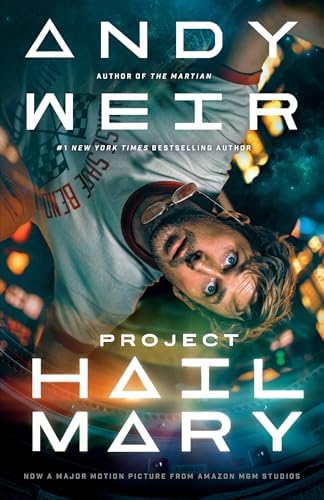
Project Hail Mary with Andy Weir
Neil deGrasse Tyson and Chuck Nice interview Andy Weir, the software engineer turned sci-fi novelist behind The Martian, Artemis, and Project Hail Mary. Weir discusses his latest work and its upcoming film adaptation starring Ryan...

Episode


- 01
Andy Weir's Project Hail Mary features astrophage, alien microbes that eat stars and threaten Earth's survival by dimming our sun
- 02
The alien species Rocky comes from a planet with 29 atmospheres of ammonia and temperatures over 200°C, requiring xenonite barriers for interaction
- 03
Rocky's species lacks object permanence due to constant 360-degree echolocation input, unlike humans who maintain spatial memory
- 04
The film adaptation of Project Hail Mary has a $250 million budget and stars Ryan Gosling as reluctant hero Dr. Ryland Grace
- 05
Weir's writing advice: 'You have to actually write, resist telling friends your story, and there's never been a better time to self-publish'
- 06
The Martian was initially self-published on Kindle Direct Publishing before becoming a bestseller and Ridley Scott film
- 07
The Iridian aliens didn't understand relativity, causing fuel miscalculations that become crucial to the plot's resolution
Get the latest ideas from StarTalk Radio.
Plus the best new takeaways from other top podcasts — read in minutes, not hours.
By continuing, you agree to podbrain's Terms and Privacy Policy.
These notes may contain occasional inaccuracies. Learn how podbrain notes are made
Neil deGrasse Tyson and Chuck Nice interview Andy Weir, the software engineer turned sci-fi novelist behind The Martian, Artemis, and Project Hail Mary. Weir discusses his latest work and its upcoming film adaptation starring Ryan Gosling.
The conversation explores the scientific foundations of Project Hail Mary, including the alien microbe astrophage that threatens Earth by dimming the sun, and the fascinating biology of Rocky, an alien species from the 40 Eridani system. Weir details how he constructed plausible alien life forms based on extreme planetary conditions.
They discuss the challenges of adapting complex scientific concepts for film, the $250 million budget for the Project Hail Mary movie, and Weir's approach to maintaining scientific accuracy while crafting compelling narratives that have made his books consistently successful in Hollywood.
From Software Engineer to Bestselling Sci-Fi Author
Andy Weir transitioned from software engineering to writing The Martian, which he initially self-published on Kindle Direct Publishing before it became a bestseller and 2015 Ridley Scott film starring Matt Damon
Artemis remains 'the only one of my books not to be made into a movie' according to Weir, though it has inspired a NASA space program of the same name
Project Hail Mary is being adapted into a $250 million film starring Ryan Gosling, with Weir serving as a producer rather than just the source author
The Science Behind Astrophage and Alien Threats
Astrophage are alien microbes that 'live on the surface of the sun and absorb energy, turning it into mass' before migrating to planets with carbon dioxide to reproduce
The organisms grow exponentially and dim stars across our local cluster, threatening to make Earth uninhabitable, except for the mysterious case of Tau Ceti
The solution involves using astrophage itself as fuel for interstellar travel through 'mass conversion propulsion' - a circular but scientifically feasible concept
Rocky: Engineering Aliens from Planetary Constraints
Weir designed Rocky's species based on the extreme conditions of 40 Eridani AB: '29 atmospheres of ammonia, temperatures over 200°C, and a magnetic field 25 times stronger than Earth's'
Rocky's pentagonal symmetry with five interchangeable arms/legs reflects a world where 'no light gets to the surface' and survival depends on echolocation
Unlike humans, Iridians 'don't have object permanence' because their constant 360-degree echolocation input eliminates the need to maintain spatial memory
The species are 'obligate carnivores' living in a biosphere that functions 'kind of like an ocean' with photophilic life at the top and predators at the bottom
Cross-Species Communication and Technology Exchange
The protagonists establish communication by starting with numbers and using computer analysis of acoustic waveforms to build a shared vocabulary
Rocky's species excels at materials science, creating xenonite barriers that allow safe interaction between incompatible atmospheres
The Iridians' lack of understanding of relativity becomes crucial to the plot, as they calculated fuel needs using Newtonian physics and ended up with excess fuel
From Page to Screen: Adaptation Challenges
Weir and screenwriter Drew Goddard fought to include a scene where 'they nuke Antarctica' to create global warming as Earth's sun dims, but runtime constraints forced its removal
The film's $250 million budget allows for non-humanoid aliens requiring complex environmental barriers, unlike typical 'rubber costume' sci-fi productions
Dr. Ryland Grace is portrayed as a 'reluctant hero' and 'selfish coward' who initially doesn't want to save the world but was 'drugged and put on' the mission against his will
Writing Advice from a Self-Published Success Story
Weir's three rules for aspiring writers: 'You have to actually write - ideating and world building is not writing, you need to type'
'Resist the urge to tell your friends and family your story - it satisfies your need for an audience and saps your will to write'
'There's never been a better time in human history to self-publish - there's no old boy network between you and readers anymore'


These notes may contain occasional inaccuracies. Learn how podbrain notes are made
More in Science & Tech

The 5-Minute AI Weekly Recap: Realignment Week
Jun 20, 2026
Why Kalshi's John Wang Says Perps Are 'the Most Pure Trading Instrument'
Jun 19, 2026Your Company Doesn’t Need an AI Strategy
Jun 19, 2026
The data black hole at the center of AI
Jun 19, 2026
The New Rules of Media | Marc Andreessen & Ben Horowitz
Jun 19, 2026
.svg)