
Cosmic Queries – The Complex Universe with Sean Carroll
Neil deGrasse Tyson hosts this StarTalk Cosmic Queries edition with co-host Chuck Nice, featuring theoretical physicist Sean Carroll. Carroll recently transitioned from Caltech to Johns Hopkins University as the Homewood Professor of Natural Philosophy, a deliberately retro title echoing Newton's era before 'physics'...

Episode


- 01
Sean Carroll explains that Hawking radiation appears invisible to falling observers because they're moving too fast to observe it due to Heisenberg uncertainty principle
- 02
Dark matter definitively exists as 'dark gravity' - we observe gravitational effects where no ordinary matter exists to cause them
- 03
The arrow of time emerges from cosmology: the early universe was highly organized 14 billion years ago and has been becoming more disorganized since
- 04
Fields like electromagnetism fill all of space with invisible vectors at every point, explaining phenomena from smartphone signals to TV remotes
- 05
Many-worlds interpretation treats all quantum possibilities as equally real - other worlds exist but don't interfere with our refrigerator
- 06
Entropy continues increasing even if the universe re-collapses because particle velocities spread out despite positions being squeezed together
- 07
The notorious delayed choice quantum eraser experiment sounds spooky but follows standard Schrödinger equation predictions without particles 'knowing' anything
- 08
Big Bang nucleosynthesis demonstrates our ability to extrapolate physics laws: scientists predicted hydrogen/helium ratios and cosmic microwave background temperature correctly
Get the latest ideas from StarTalk Radio.
Plus the best new takeaways from other top podcasts — read in minutes, not hours.
By continuing, you agree to podbrain's Terms and Privacy Policy.
These notes may contain occasional inaccuracies. Learn how podbrain notes are made
Neil deGrasse Tyson hosts this StarTalk Cosmic Queries edition with co-host Chuck Nice, featuring theoretical physicist Sean Carroll. Carroll recently transitioned from Caltech to Johns Hopkins University as the Homewood Professor of Natural Philosophy, a deliberately retro title echoing Newton's era before 'physics' existed as a term.
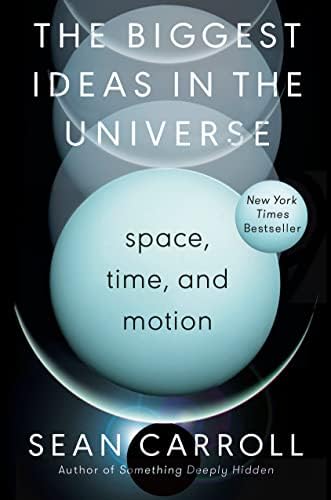
The conversation explores Carroll's latest work in his three-volume series 'The Biggest Ideas in the Universe,' including his recent books Space, Time, and Motion and Quanta and Fields, with the upcoming third volume Complexity and Emergence scheduled for 2026. Carroll also discusses his recent paper on Hawking radiation and addresses fundamental questions about quantum mechanics, dark matter, and the nature of time.
Throughout the discussion, Carroll draws from his comprehensive treatment of physics in Something Deeply Hidden, particularly when explaining quantum mechanical phenomena and the many-worlds interpretation to address listener questions about the universe's most perplexing mysteries.
From Faraday's Lines of Force to Modern Field Theory
Fields were initially hard to accept because they're invisible - Faraday could demonstrate magnetic fields with iron filings, but without them, the field seemed imaginary yet still present.
Newton worried about 'action at a distance' in gravity, saying 'this is over my pay grade' and leaving the mechanism for future generations to discover.
Faraday was a 'genius, intuitive physicist' who published papers without equations, focusing on 'lines of force' rather than mathematical field theory.
Maxwell made Faraday's insights 'mathematically respectable,' describing electric and magnetic fields as 'little arrows at every point' that explain heat, light, radio waves, and x-rays as electromagnetic phenomena.
What Hawking Radiation Looks Like Inside Black Holes
Carroll's recent paper with graduate student Chris Shalou resolves the apparent contradiction between seeing Hawking radiation from far away versus seeing nothing special when crossing the event horizon.
'There is high intensity radiation when you're crossing the event horizon, but you're moving so fast that you don't have time to observe it' - Sean Carroll, explaining the Heisenberg uncertainty principle solution.
The resolution involves time dilation effects: observers falling into black holes experience such rapid motion that quantum uncertainty prevents them from detecting the radiation they theoretically encounter.
Dark Matter as Definitive Dark Gravity
Carroll emphasizes that dark matter 'definitively exists' based on cosmic microwave background evidence, moving beyond 1980s debates about modified gravity theories.
'We see gravity where there is no ordinary matter to cause it' - the evidence now shows gravitational effects pointing at invisible sources rather than just modified gravitational strength.
Dark matter behaves 'exactly like some massive, slowly moving particle' with well-understood distribution, velocity, and quantity throughout the universe.
Even modified gravity theories secretly include 'new sources of gravity in there, which are just dark matter' - they don't eliminate the need for additional invisible matter.
The Cosmological Arrow of Time
The arrow of time emerges from cosmology: 'The early universe, 14 billion years ago, near the Big Bang, was in a very special organized state, and it's becoming more disorganized.'
Carroll distinguishes between time itself and the arrow of time, comparing it to spatial directions: 'The earth is just distinguishing between two different directions in space up and down. That's what entropy does for the universe.'
Even if the universe re-collapsed, entropy would continue increasing because 'particle velocities spread out and do crazy things' despite positions being squeezed together.
Demystifying Quantum Mechanics Misconceptions
The notorious delayed choice quantum eraser experiment 'makes people feel bad for no good reason' because it follows standard quantum mechanics without particles 'knowing' anything or time travel effects.
Carroll wrote about this in Something Deeply Hidden but removed the chapter because 'this is too much. Like they don't need this. Like this is too complicated and specific.'
Many-worlds interpretation treats all quantum possibilities as equally real: 'If you take our possibility as real, then you have two choices' - either accept other worlds or create 'disappearing worlds theories.'
Copenhagen interpretation claims 'there is no such thing as what the system is doing before you measure it' - reality consists only of measurement outcomes.
The Success of Physics Extrapolation
Big Bang nucleosynthesis demonstrates remarkable predictive power: scientists used nuclear physics and cosmology rules to correctly predict hydrogen and helium ratios in the universe.
George Gamow predicted cosmic microwave background temperature would be 10 degrees; actual measurement showed 3 degrees - 'like predicting that a 10-foot flying saucer would land on the lawn of the White House, but it was a three-foot flying saucer.'
Carroll expresses confidence in human intellect reaching a theory of everything: 'The rate at which we've been learning things... 10,000 years from now, we're going to know a lot.'


These notes may contain occasional inaccuracies. Learn how podbrain notes are made
More in Science & Tech

The 5-Minute AI Weekly Recap: Realignment Week
Jun 20, 2026
Why Kalshi's John Wang Says Perps Are 'the Most Pure Trading Instrument'
Jun 19, 2026Your Company Doesn’t Need an AI Strategy
Jun 19, 2026
The data black hole at the center of AI
Jun 19, 2026
The New Rules of Media | Marc Andreessen & Ben Horowitz
Jun 19, 2026
.svg)