
The Book of Elon - Part 3
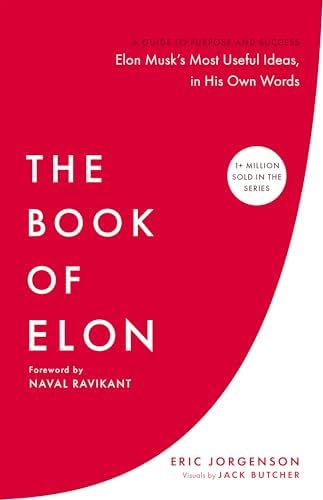
This transcript features Eric Jorgenson, author of The Book of Elon A Guide to Purpose and Success, introducing his third free book following the success of The Almanac of Naval Ravikant, which reached over 5...

Episode


- 01
Eric Jorgenson gives away The Book of Elon for free because 'if you can't confidently afford the five bucks for the Kindle version, then I want you to have this information even more'
- 02
Elon started with $2,000 and a backpack in Canada at 17, working dangerous jobs like cleaning pulp boilers for $18/hour before founding his first company
- 03
PayPal's viral growth exploded from 0 to 100,000 customers in the first month, requiring $60-70 million in incentives to build the network effect
- 04
Tesla nearly died in 2008 when Elon 'literally had to borrow money for rent' after investing everything into SpaceX and Tesla during the financial crisis
- 05
SpaceX succeeded on the fourth launch attempt with Elon's last remaining funds - 'If the fourth launch hadn't worked, that would have been curtains'
- 06
Current Mars transport costs $1 billion per ton; Starship aims to reduce this to under $100,000 per ton - a 10,000x improvement
- 07
Elon lived in Tesla's factory for three years during Model 3 production hell, sleeping on the floor so workers knew he shared their pain
- 08
Both Tesla and SpaceX had less than 10% probability of success when founded - 'Who starts a car company and rocket company expecting them to succeed?'
Get the latest ideas from Smart Friends.
Plus the best new takeaways about space from other top podcasts — read in minutes, not hours.
By continuing, you agree to podbrain's Terms and Privacy Policy.
These notes may contain occasional inaccuracies. Learn how podbrain notes are made
This transcript features Eric Jorgenson, author of The Book of Elon A Guide to Purpose and Success, introducing his third free book following the success of The Almanac of Naval Ravikant, which reached over 5 million readers. Jorgenson explains his philosophy of making important ideas accessible regardless of financial means, offering the complete book in PDF, EPUB, and audiobook formats at no cost.
The content covers Elon Musk's entrepreneurial journey from his arrival in Canada with $2,000 to building three revolutionary companies. The discussion spans his early struggles working dangerous manual labor jobs, the founding and sale of Zip2, the creation and evolution of PayPal through viral growth and strategic pivots, and the near-death experiences of both Tesla and SpaceX during the 2008 financial crisis.
The narrative explores Musk's systematic approach to entering capital-intensive industries like automotive and aerospace, his philosophy of vertical integration and first-principles thinking, and the technical challenges of achieving full rocket reusability. Throughout, the focus remains on the practical decisions, financial constraints, and engineering breakthroughs that enabled these companies to survive and ultimately transform their respective industries.
From South Africa to Silicon Valley: The $2,000 Beginning
Elon arrived in Montreal at 17 with 'a backpack, a suitcase of books, and $2,000' after getting his Canadian passport through his mother's citizenship.
He worked the 'hardest job I've ever had' at a lumber mill for $18/hour, crawling through hazmat suit tunnels to clean steaming sand from pulp boilers with only one entrance.
After studying physics at Queen's University and UPenn, he dropped out of Stanford graduate school with $110,000 in college debt to start his first company.
The decision came when he realized the internet was 'happening in 1995' and he could be 'pretty sure success was one of the outcomes for an internet company.'
Zip2: Building the First Internet Maps While Sleeping in the Office
Unable to get hired at Netscape despite hanging out in their lobby, Elon started Zip2 with his brother, creating 'the first map and directions on the internet' with patent number 5944769.
The company operated with 'an absurdly tiny burn rate' - they slept in the office, showered at the YMCA, and drilled through the floor to connect to internet service for $100/month.
Moore Davido Ventures invested $3 million for 60% of the company, which seemed 'crazy' and 'insane to give us so much money for a company that consisted of six people.'
Compaq acquired Zip2 for 'a little over $300 million in cash' in early 1999, with Elon receiving $21.5 million and immediately putting 'almost all of that into X.com.'
PayPal's Viral Explosion: From Email Payments to eBay Exit
X.com initially focused on comprehensive financial services but pivoted when 'nobody was interested' in the complex features while 'everybody was interested' in simple email payments.
PayPal achieved explosive viral growth, reaching 100,000 customers in the first month and requiring $60-70 million in incentives ($20 per signup, then $10, then $5) to build network effects.
The company merged with Peter Thiel's Confinity after realizing 'we're going to bludgeon each other to death' competing in the same Palo Alto building.
Elon was removed as CEO during a critical period when he left for a combined 'financing trip and honeymoon,' though he later reconciled with the team and invested in their future ventures.
eBay acquired PayPal for $1.5 billion in October 2002, with Elon immediately deciding to 'put almost all of it back into a new game' rather than retire to 'one of the islands in the Bahamas.'
Tesla's Near-Death Experience: Three Years of Manufacturing Hell
Tesla's founding premise was 'basically completely wrong' - the plan to combine Lotus Elise chassis with AC Propulsion technology resulted in only '7% of the parts' being common with the original Lotus.
During the 2008 financial crisis, Elon faced an impossible choice: 'I had maybe $30 or $40 million left' and had to decide whether to save Tesla or SpaceX, ultimately splitting the money between both companies.
Tesla closed its survival funding round 'at 6 p.m. on Christmas Eve, 2008' - 'the last hour of the last day possible' before bouncing payroll, with Daimler's $50 million investment proving crucial.
During Model 3 production, Elon 'lived in the Fremont and Nevada factories for three years' and 'slept on the floor so the team going through a hard time could see me on the floor.'
The production crisis required going 'ultra hardcore' with 'a level of intensity greater than anything they had experienced before,' resulting in 'three years of hell' but ultimately saving the company.
SpaceX: Betting Everything on the Fourth Launch
SpaceX began when Elon realized 'we were able to go to the moon in 1969' but 'here we are half a century later, and we still have not gone back to the moon.'
After three failed launches, Elon told the team 'we have one last rocket' and 'six weeks' to succeed, having budgeted for only three attempts with his remaining funds.
The fourth launch succeeded, prompting Elon to scream 'I love NASA! You guys rock!' when they called with a contract, though he 'couldn't feel celebratory' due to clinically high cortisol levels.
SpaceX achieved reusability with Falcon 9 despite being told 'rocket reusability was impossible,' bringing boosters back and reflying them to reduce costs by 75% compared to competitors.
Starship: Engineering the 10,000x Mars Cost Reduction
Current Mars transport costs 'more than a billion dollars' per ton of useful payload, requiring reduction to 'less than $100,000 a ton' - a 10,000x improvement - to build a self-sustaining Mars city.
Starship is 'the largest flying object of any kind' at 5,000 tons liftoff weight and 9-meter diameter, designed for full and rapid reusability where 'the only thing we do between flights is maintenance and refuel.'
The revolutionary tower catch system uses 'giant robot arms catching a giant rocket' to eliminate landing legs and enable rapid reuse, with the booster potentially reflying 'within an hour of landing.'
With full reusability, 'Starship 3 will cost significantly less per flight than Tiny Falcon 1' despite carrying 400 times more payload, demonstrating the economics of reusable versus expendable systems.

These notes may contain occasional inaccuracies. Learn how podbrain notes are made
More in Finance & Business

The Biggest Pivot In AI History Is Happening Right Now | Jordi Visser
Jun 20, 2026
How Substack Creators Are Covering This Strange Markets Era
Jun 20, 2026
#422 Joseph Pulitzer
Jun 20, 2026
World's First Trillionaire, Anthropic Fable Banned, The New Oligarchs, Iran Peace Deal
Jun 19, 2026Anthropic's Co-Founder and Top Economist on Doing Research at the AI Frontier
Jun 19, 2026
.svg)