
Brian Potter - How to Fix America's Building Problem
Brian Potter is a structural engineer, Senior Infrastructure Fellow at the Institute for Progress, and author of The Origins of Efficiency. He spent two and a half years at the failed construction startup Katerra, which raised $2...

Episode


- 01
Katerra raised $2 billion but failed because they scaled operations before achieving product-market fit, building a $100 million CLT plant they immediately tried to abandon
- 02
Sweden builds 80-90% of single-family homes using prefabrication yet their housing costs exceed US prices, debunking the factory efficiency myth
- 03
AI datacenter buildout represents 'one of the great infrastructure construction efforts in history' comparable to Manhattan Project or Apollo program investment levels
- 04
Construction productivity has stagnated for decades while other industries improved dramatically through automation and technological advancement
- 05
The Power Broker triggered a shift from Hamiltonian (pro-government capability) to Jeffersonian (anti-government power) impulses that now throttle infrastructure development
- 06
Local NIMBY opposition creates 'concentrated harms versus diffuse benefits' problem where neighborhood disruption outweighs citywide housing affordability gains
- 07
Federal government has significant leverage over energy infrastructure permitting but limited ability to override local housing development restrictions
Get the latest ideas from Infinite Loops.
Plus the best new takeaways about artificial intelligence from other top podcasts — read in minutes, not hours.
By continuing, you agree to podbrain's Terms and Privacy Policy.
These notes may contain occasional inaccuracies. Learn how podbrain notes are made
Brian Potter is a structural engineer, Senior Infrastructure Fellow at the Institute for Progress, and author of The Origins of Efficiency. He spent two and a half years at the failed construction startup Katerra, which raised $2 billion attempting to revolutionize building through factory prefabrication methods.
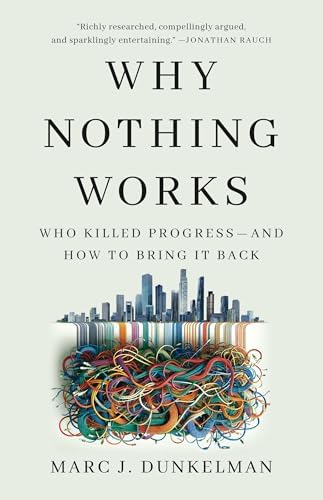
The conversation explores why construction productivity has stagnated while other industries have dramatically improved, examining the recurring failures of prefabrication attempts from Sears mail-order homes through modern startups. Potter draws on insights from Why Nothing Works by Mark Dunkelman to explain how American politics shifted from a Hamiltonian impulse favoring government capability to a Jeffersonian suspicion that has created regulatory barriers to infrastructure development.
Potter discusses the tension between local opposition to development and broader economic benefits, the surprising success of AI datacenter construction, and potential solutions ranging from federal permitting reform to changing cultural attitudes about growth and progress.
Katerra's $2 Billion Prefabrication Failure
Katerra attempted to revolutionize construction through factory-built prefabrication, an idea that 'is perennially popular' with someone trying it 'every 10 to 20 years' - Brian
The company scaled operations before achieving product-market fit, building what Potter believes was 'the largest CLT plant in the world' for cross-laminated timber panels
'Almost as soon as they got it online, they were sort of trying to get rid of it because it no longer fit what they were trying to do' - Brian
COVID disrupted operations, but Potter notes the fundamental problem was 'constantly trying to sort of figure out what that needed to be' rather than having a proven product to scale
The Prefabrication Myth Across History
Sears sold nearly 100,000 mail-order houses from 1908-1940 based on 'knockdown boat' assembly concepts, but ultimately lost money on mortgages during the Great Depression
Ford's Model T mass production success in the 1930s inspired widespread belief that 'the same ideas should work' for complex houses assembled like cars
Sweden builds 80-90% of single-family homes and 40% of apartment buildings using prefabricated construction, yet 'their costs are not like low' and exceed US housing prices
The recurring thesis that 'if I move my process into the factory, it will become much more efficient' has failed repeatedly across decades of attempts
From Hamiltonian Power to Jeffersonian Paralysis
Why Nothing Works by Mark Dunkelman describes competing tendencies: Hamiltonian 'robust muscular government' versus Jeffersonian suspicion that views government as 'a big danger to its citizenry'
The Power Broker biography of Robert Moses marked a turning point where 'people started becoming much more suspicious of the government's power and authority' in the late 1960s-early 1970s
Environmental laws like the National Environmental Policy Act, while 'good rules,' also 'serve to restrict what the government is able to do' and enable litigation to halt projects
'We've been on the end of several decades of this Jeffersonian impulse reigning supreme' leaving government agencies unable to accomplish major infrastructure projects - Brian
AI Infrastructure: The Exception That Proves the Rule
Current AI datacenter buildout represents 'one of the great infrastructure construction efforts in history' comparable to 'Manhattan Project or Apollo' in capital deployment
Datacenters succeeded initially because they 'paid a lot property taxes, but they didn't demand all that much in the way of new government services' unlike population-dense developments
'We can still deploy infrastructure and resources to build capabilities really, really astoundingly quickly if there's motivation to and if stuff is not blocking the way' - Brian
Growing opposition now emerges as new datacenters stress power and water infrastructure while 'AI capabilities are making so many people nervous'
The Local NIMBY Problem: Concentrated Harms vs Diffuse Benefits
'A city overall will benefit from population growth' through 'bigger, stronger economy, more division of labor' but costs are 'concentrated right next to that one spot' - Brian
Federal housing czar would face limitations since 'a lot of restrictions on building things are at the state or regional or local level' through city supervisors and design review boards
Federal government has 'a lot more ability to influence' large-scale energy infrastructure through permitting reform for transmission lines, pipelines, and solar installations
California's transformation from growth-celebrating state with population tracking signs to anti-growth policies in the 1960s exemplifies how affluence breeds opposition to development
AI's Promise for Construction and Automation
'AI is going to make dramatically new types of automation possible' reducing 'tasks that you used to be having to do manually' - Brian
Current AI excels at 'any information processing task' but robotics capabilities 'are not as good as driving a robot around yet' compared to chatbot performance
'If you could automate a big fraction of construction work, you would be able to drive down the cost of building' and 'finally address this construction productivity problem'
Potter speculates a 'robot GPT-3 moment' could emerge from training models on human teleoperation data, potentially requiring 'many millions of dollars' but 'maybe less than you might expect'


These notes may contain occasional inaccuracies. Learn how podbrain notes are made
More in Finance & Business

The Biggest Pivot In AI History Is Happening Right Now | Jordi Visser
Jun 20, 2026
How Substack Creators Are Covering This Strange Markets Era
Jun 20, 2026
#422 Joseph Pulitzer
Jun 20, 2026
World's First Trillionaire, Anthropic Fable Banned, The New Oligarchs, Iran Peace Deal
Jun 19, 2026Anthropic's Co-Founder and Top Economist on Doing Research at the AI Frontier
Jun 19, 2026
.svg)