
World Collapse Expert (Ian Bremmer): The Real Crisis Is What Comes After Trump
Professor Ian Bremmer, one of the world's leading political scientists and head of Eurasia Group, discusses his annual top risk report highlighting the three most critical global threats. Bremmer has spent 30 years analyzing geopolitical risks to help decision-makers understand the global environment.

Episode


- 01
The United States has become the biggest driver of geopolitical uncertainty in the world, abandoning the rules it historically established
- 02
Trump will fail due to policy incompetence and unwillingness to take on expertise, losing midterms and becoming a lame duck
- 03
China's long-term investment in critical minerals and electric vehicles positions them for stronger future trajectory than short-term focused competitors
- 04
Anthropic created an AI model so powerful they couldn't release it because it would pose immediate systemic risk to global economy
- 05
Iran maintains centralized decision-making capacity despite military degradation, showing up to 21-hour negotiations with substantial leadership team
- 06
AI data centers are generating unprecedented constituent anger over jobs, energy costs, and neighborhood impacts according to US senators
- 07
Three governance solutions needed: US-China AI arms control, AI stability board like Financial Stability Board, and universal AI access funding
Get the latest ideas from The Diary Of A CEO.
Plus the best new takeaways about artificial intelligence from other top podcasts — read in minutes, not hours.
By continuing, you agree to podbrain's Terms and Privacy Policy.
These notes may contain occasional inaccuracies. Learn how podbrain notes are made
Professor Ian Bremmer, one of the world's leading political scientists and head of Eurasia Group, discusses his annual top risk report highlighting the three most critical global threats. Bremmer has spent 30 years analyzing geopolitical risks to help decision-makers understand the global environment.
The conversation covers the US political revolution driving global uncertainty, China's strategic positioning through critical minerals and technology, and the emerging AI governance crisis. Bremmer explains how Trump's Iran intervention failed, why Europe has fallen behind economically, and what solutions exist for managing AI's disruptive potential.
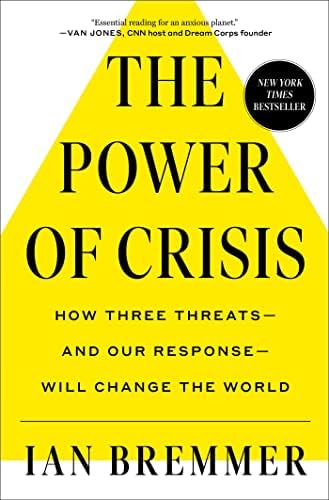
Drawing from his recent work including The Power of Crisis, Bremmer argues that technology companies have become more powerful than traditional nation-states, while warning that artificial intelligence poses both unprecedented opportunities and existential governance challenges requiring immediate international coordination.
America's Political Revolution Drives Global Uncertainty
The United States has become the biggest driver of geopolitical uncertainty globally, with Americans themselves rejecting the free trade system, global policeman role, and open borders they historically championed.
"Trump will fail" due to policy incompetence and unwillingness to engage expertise, becoming unpopular and losing midterms badly - "Republicans will start to think about their own futures as opposed to holding on to this 80-year-old guy" - Ian.
The underlying demand for political revolution will persist even after Trump fails, with uncertain outcomes: "We don't know, is it going to come from the left or the right, but we know that that level of uncertainty is growing" - Ian.
Global leadership vacuum emerges as Americans refuse traditional leadership role while no other country can fill those shoes, creating a "G0" world where "the powerful make the rules that are useful to them, and the weak have to accept that" - Ian.
China's Strategic Advantage Through Critical Minerals
China has invested decades in building global dominance over critical minerals, rare earths, electric vehicles, and batteries while other countries focused on "just in time, globalization" and quarterly returns.
Critical minerals like lithium and antimony are essential for "every device, in your car battery, it's in your missile systems and your advanced weaponry" - Ian, giving China leverage over advanced economies.
As countries hedge against American unpredictability, "many more countries are saying, well, we want to hedge and do more with the Chinese" - creating long-term trajectory favoring China despite current economic challenges.
Trump's Iran Strategy: Three Reasons for Military Action
Venezuela success emboldened Trump: "Not a single American serviceman or woman is killed. They go in, they take Maduro out" - creating a new cooperative government and regional stability that leaders across South America praised.
Previous Iranian restraint gave Trump confidence: During his first presidency, Iran "talked big, did not hit the Americans" even after Soleimani assassination, leading Trump to believe "they don't want to fight me" - Ian.
Unlike his first term with independent advisors like "Mike Pompeo or Mad Dog Mattis," Trump now has advisors who "are first and foremost loyal to the president" and won't push back on incompetent decisions.
Iran War Reality: Decentralized Response and Stalemate
Iranian leadership implemented "mosaic situation" - decentralizing military decisions to local commanders to prevent Israeli targeting of high-level communication, while maintaining central coordination capacity.
21-hour Pakistan negotiations with substantial Iranian delegation including foreign minister and parliament speaker proved "this regime is still very much functioning despite all of the Israeli and American efforts."
Trump's blockade announcement came "just hours ago" but "just before markets open on Monday, you also see reporting that, well, these talks that were a disaster, we're going to engage in further talks."
Most likely outcome involves Iranian compromise on nuclear enrichment in exchange for privileged position on Strait of Hormuz transit, as "they never had nukes. They weren't going to get nukes. If they got nukes, they were going to get blown up."
Europe's Economic Decline and Regulatory Overreach
European decline stems from demographic contraction, flat growth, reduced productivity, and failure to invest in defense or technology while believing "the world was just going to be peaceful" after 1989.
Technology executive explained EU battery regulations force companies to "buy loads of batteries and keep them on the shelf, and then they're going to go bad" while making devices non-waterproof, causing more environmental damage.
"We just don't need their market anymore. Brazil's coming online, and all these other big markets are coming online as buyers. So we just can decide just to not sell to Europe" - technology CTO.
The Draghi plan provides 800-page competitiveness roadmap for entrepreneurship and technology investment, "but unlike the United States, unlike China, Europe is not a country. Europe is 27 countries" - making coordination difficult.
AI Governance Crisis: From Anthropic to Unemployment
Anthropic's unreleased AI model "could find security vulnerabilities in lots of different applications" and "posed a cybersecurity risk" to banks and critical infrastructure, prompting emergency Fed meetings with bank CEOs.
"AI is now less popular than ICE in the United States" as people see major corporations getting richer while workers train AI systems to replace themselves, creating political backlash for 2028.
US Senator reported unprecedented constituent anger: "I can't talk about data centers. I've never seen people, my constituents, so upset about an issue as they do about data centers" - citing job losses and rising energy costs.
Three governance solutions needed: US-China AI arms control discussions, AI stability board with technocratic oversight like Financial Stability Board, and funding for universal AI access to prevent "different species" gap between AI-enabled and non-enabled humans.
These notes may contain occasional inaccuracies. Learn how podbrain notes are made
.svg)