
Most Replayed Moment: Neuroscientist’s Proof Of Life After Death! Dr Tara Swart
Dr. Tara Swart is a neuroscientist, psychiatrist, and author who has spent years researching consciousness and communication beyond traditional sensory perception. After losing her husband Robin to leukemia in 2021, she embarked on a scientific journey to understand whether the mind can exist independently of the body.

Episode


- 01
Neuroscientist Tara Swart claims 100% certainty that she can communicate with her deceased husband Robin through expanded sensory awareness and signs
- 02
Terminal lucidity shows people with irreversibly damaged brains becoming completely lucid hours before death, challenging mind-body connection assumptions
- 03
Dr. Bruce Grayson has documented over 5,000 near-death experience cases, including patients receiving information they couldn't have known
- 04
Humans possess 34 senses beyond the traditional five, including non-conscious senses like blood pH and oxygen-carbon dioxide balance
- 05
Grief creates psychosis-like brain changes, altering neurotransmitter levels and electric-chemical signaling patterns similar to mental illness
- 06
The shared trait vulnerability model shows creativity and mental illness share hyperconnectivity, novelty salience, and reduced cognitive filtering
- 07
Professor Donald Hoffman suggests consciousness, not space-time, forms the basis of how the universe operates
- 08
Communication with the deceased requires both parties to 'learn a language' - a process Swart says took years to develop
Get the latest ideas from The Diary Of A CEO.
Plus the best new takeaways from other top podcasts — read in minutes, not hours.
By continuing, you agree to podbrain's Terms and Privacy Policy.
These notes may contain occasional inaccuracies. Learn how podbrain notes are made
Dr. Tara Swart is a neuroscientist, psychiatrist, and author who has spent years researching consciousness and communication beyond traditional sensory perception. After losing her husband Robin to leukemia in 2021, she embarked on a scientific journey to understand whether the mind can exist independently of the body.
The conversation explores Swart's claims about communicating with her deceased husband through what she describes as expanded sensory awareness, drawing from research into near-death experiences, terminal lucidity, and the neuroscience of grief. She discusses her book The Signs, which documents her methodology for interpreting signs and developing what she believes is genuine two-way communication with the deceased.
Swart presents evidence from cases like terminal lucidity - where people with severe brain damage suddenly become lucid before death - and near-death experiences documented by researchers like Dr. Bruce Grayson. She argues that these phenomena suggest consciousness operates independently of physical brain matter, challenging conventional neuroscientific understanding.
The Journey from Grief to Scientific Investigation
Robin died in 2021 after being given two weeks to live but surviving three and a half weeks, passing away two days before their fourth wedding anniversary, leaving Swart 'totally lost and broken' despite her medical training
Six weeks after Robin's death, Swart experienced a physical encounter: 'I got woken up by a massive thump to my shoulder... I could see next to my bed a very vague, hazy version of Robin, as if he was pushing himself through treacle to be seen'
After consulting mediums and finding them unimpressive, Swart decided: 'if it's possible to communicate with someone that's passed away... I should be able to do it myself' - beginning her research journey documented in The Signs
The Science of 34 Human Senses and Trauma Response
Humans possess 34 senses beyond the traditional five, including non-conscious ones like blood pH levels and oxygen-carbon dioxide balance that can't be directly controlled but influence behavior
On the first anniversary approach, Swart experienced unexplained physical pain starting October 4th - later realizing this was the exact date she had taken Robin home from hospital to die, showing how 'my body had' remembered the trauma
Trauma shuts down brain areas responsible for articulating speech, explaining phrases like 'speechless' or 'dumbfounded' and requiring somatic work like massage, dance, or Tai Chi rather than just talking therapy
In the weeks after Robin's death, Swart would wake 'absolutely freezing cold, like shaking and shivering' requiring extreme heating, later connecting this to Robin's hatred of cold and his time in refrigerated morgue drawers
Developing Communication Through Signs and Synchronicities
Communication development 'took me years' and 'I believe it took him years as well' - like 'two people having to learn a language to speak to each other' through specific sign requests and responses
By the second anniversary, Swart could request specific signs: asking Robin for a phoenix symbol while traveling, she flew through Phoenix, Arizona on his anniversary date and passed a restaurant called Phoenix Garden daily
Advanced sign communication involves precise criteria: 'sometimes I say I need to see a button or a symbol of a button or the word button, but it's got to happen three times by 11 p.m. tomorrow'
Current communication occurs 'on a daily basis' through either asking questions mentally and receiving answers 'that I know isn't my own thought' or receiving direct messages from Robin
Terminal Lucidity and Near-Death Experience Evidence
Terminal lucidity occurs 'within one to 24 hours of death' when someone with irreversibly damaged brain function 'suddenly becomes completely lucid' - a phenomenon medicine cannot explain
An 82-year-old Alzheimer's patient who was 'non-verbal and non-responsive' for years suddenly 'sat up in hospital, looked around, and recognized her daughter by name' before dying peacefully that night
Dr. Bruce Grayson documented a case where a cardiac arrest patient saw his deceased primary nurse in a near-death experience, who told him to 'tell my parents I'm sorry about the red MG' - information he couldn't have known
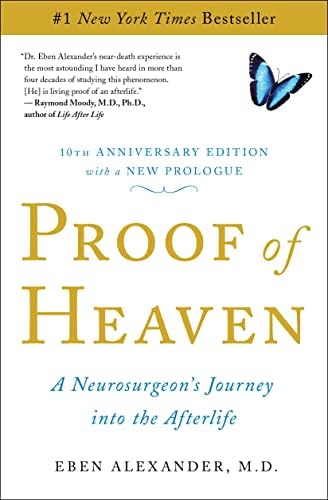
Proof of Heaven author Dr. Eben Alexander, formerly an atheist doctor, experienced clinical death from bacterial meningitis and 'came back and said that he saw heaven' and now believes in a benevolent God
Professor Alexander Baciani's work in Threshold suggests that 'at the border of life and death, we see something that is true all along' - that mind and body can operate independently
The Neuroscience of Expanded Awareness and Creativity
The shared trait vulnerability model shows creativity and mental illness share three neurological features: hyperconnectivity, novelty salience (noticing new things), and attenuated latent inhibition (loosened cognitive filtering)
Grief creates 'psychosis-like' brain changes, altering neurotransmitter levels and 'electric and chemical signaling' similar to mental illness, making expanded perception possible during vulnerable states
High IQ and cognitive flexibility with these traits enable creativity and expanded awareness, while low IQ with the same traits can lead to psychological crisis through perseveration
The reticular activating system filters survival-crucial information, but expanded awareness involves 'the art of noticing' things that could be 'crucial to you thriving rather than just surviving'
Scientific Implications for Consciousness Research
The only explanation for terminal lucidity is 'that the mind is not emergent from material matter' since neurochemicals cannot function through physically damaged neurons and synapses
Dr. David Eagleman at Stanford supports the theory that 'the brain being like a radio and receiving signals from outside' cannot be disproven, challenging materialist consciousness models
Professor Donald Hoffman suggests 'consciousness is the basis of how the universe works' rather than space-time, representing a fundamental shift in scientific understanding
Swart argues scientists must challenge status quo: 'You can't, as a scientist, believe that everything we know now is all there is. There's no point to being a scientist if that's what you believe'

These notes may contain occasional inaccuracies. Learn how podbrain notes are made
.svg)